Bookshelf

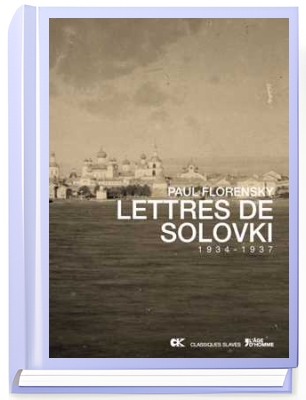
Père Pavel Florensky. Lettres de Solovki. 1934-1937. 748 pages. L’Age d’Homme. Lausanne-Paris. Nov. 2012

Collection Classiques slaves. Traduit du russe et présenté par Françoise Lhoest.

Pavel (Paul) Alexandrovitch Florensky (1882-1937) était un théologien orthodoxe russe, philosophe, mathématicien, inventeur et néomartyr. Il fut parfois comparé par ses contemporains, du fait de l’étendue des domaines auxquels il s’intéressait et dans lesquels il excellait, à Léonard de Vinci. Arrêté en 1933 et condamné à dix ans de goulag, il fut exécuté au camp de Solovki en 1937.

«Quand j’avais ton âge − écrit Florensky (lettre no 77) à son fils Mikhaïl âgé de quinze ans − chaque minute perdue me semblait un malheur ou un crime et j’essayais de remplir mon temps au maximum. J’avais des cahiers où je notais tout l’essentiel de mes lectures et  mes réflexions sur les livres, des cahiers de citations intéressantes, des albums de croquis d’après nature, des cahiers d’expériences, des carnets pour les observations sur le terrain (...)

C’est ainsi que j’ai acquis un bagage de connaissances, des aptitudes pratiques et surtout l’habitude de juger par moi-même en fonction de ce que j’avais observé. Les données que je récoltais, je tâchais de les confronter et d’en faire des synthèses sous forme de tableaux, de diagrammes, de cubes ... »

Envers et contre tout, au goulag des îles Solovki, Florensky ne manque pas une occasion de faire de même, comme on le voit par toute  sa correspondance, lui qui avait cherché à faire de sa vie une œuvre d’art, trouve la beauté partout où la nature sauvage n’a pas été abîmée par la main de l’homme, surtout de l’homme du goulag. C’est cette beauté qui lui donne la force de vivre et d’insuffler de l’optimisme et des perspectives scientifiques et culturelles aux siens, à sa famille et aussi à ses codétenus.

Aussi paru chez L'Age d'Homme:

Père Paul Florenski. La Colonne et le Fondement de la Vérité, essai d’une théodicée orthodoxe en douze lettres.  Traduit du russe par Constantin Andronikof. L’Age d’Homme. 1975.

Lisez ici l'article du professeur Georges Nivat à ce sujet.

About the author

Nadia Sikorsky

Nadia Sikorsky was born and raised in Moscow. She graduated from the Faculty of Journalism at Moscow State University and went on to complete her postgraduate studies there, earning a PhD in History. She spent 13 years at UNESCO, first in Paris and then in Geneva. After serving as Director of Communications at Green Cross International, founded by Mikhail Gorbachev, she launched NashaGazeta.ch in 2007, Switzerland’s first Russian-language online daily newspaper.

In 2022, Nadia Sikorsky was named to Le Temps’ Forum des 100, which brings together individuals who, in the newspaper’s view, have “significantly contributed to the success of French-speaking Switzerland”, from across public life, business, politics, science and culture.

After 18 years at the helm of NashaGazeta.ch, Nadia Sikorsky decided to devote herself to what had always held a special place in her work as a journalist: culture in all its diversity. This led to the creation of Russian Accent, a trilingual cultural blog in Russian, French and English, born in the heart of Europe, in Switzerland, which has become her second home and whose multiculturalism and multilingualism have helped shape the character of this new project.

At the heart of the project is the perspective of a European of Russian origin, drawing on more than 35 years of professional experience and a deep knowledge of both cultural traditions. Nadia Sikorsky sees her role as that of a cultural mediator between the two. The title of the blog, Russian Accent, reflects this idea: the accent is neither a linguistic barrier nor a political position, but a distinctive cultural imprint within a European context.

Events
Most read

A new book by the Geneva-based Slavist Jean-Philippe Jaccard and his Russian colleague Andrei Ustinov, now living in San Francisco, has been published by the European University at St Petersburg: Vzir Zaumi. Daniil Harms and the Literary Avant-Garde of the 1920s. In the authors' own words, the volume offers a kind of X-ray of Leningrad's "left-wing " circles and their evolution during the period between Harms's poetic debut and the creation of OBERIU, as well as the dynamics that shaped those circles.

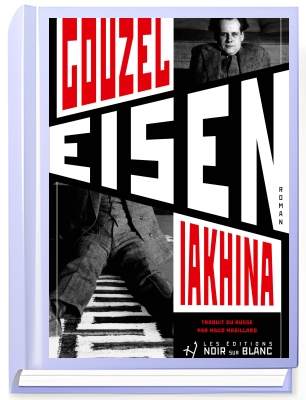
A few days ago, the Lausanne-based publisher Éditions Noir sur Blanc brought out Guzel Yakhina’s novel about the celebrated Soviet film director Sergei Eisenstein. French readers will be able to read it in Maud Mabillard’s translation and, importantly, in full, including the ninth chapter omitted from the Russian edition.