Nous assistons à la fin de l'ère dollar qui dure depuis la Seconde Guerre Mondiale. Le dollar n'est plus la monnaie la plus sûre du monde. Il n'est plus la monnaie d'une superpuissance responsable, performante et hautement productive. Il est la monnaie d'une économie déclinante, arrivée au point de non-retour, techniquement en faillite. Le billet vert est en train de dévoiler son vrai visage: celui d'une arme du désespoir, utilisée par une grande puissance malade, qui a trop longtemps caché l'état désastreux de son économie derrière sa planche à billets.
Suite aux dérives majeures de la politique monétaire américaine, le dollar est devenu, aujourd'hui, la plus grande bulle spéculative de l'histoire. Le statut du dollar comme référence du système monétaire international devient intenable. Il est contesté par des puissances désormais plus riches, comme la Chine. Ce changement de régime majeur se perçoit dans l'envolée de l'or et dans les tensions croissantes entre les Etats-Unis et le reste du monde.
Cet ouvrage veut avant tout briser le tabou qui entoure le dollar en procédant à un examen sans complaisance de la situation réelle des Etats-Unis, et en la comparant à celle des blocs européen et asiatique. La conclusion est que le dollar, dont la valeur repose sur une perception subjective, ne résiste pas à la rationalité. Même aujourd'hui, après cette sorte de défaut déguisé qu'est la dévaluation compétitive, le dollar est encore largement surévalué.
En attendant, il s'agit de se préparer à l'inévitable changement, en réfléchissant d'une part à une sortie ordonnée du dollar par les banques centrales, et d'autre part au futur système monétaire international qui émergera pour tenir compte des nouvelles réalités.
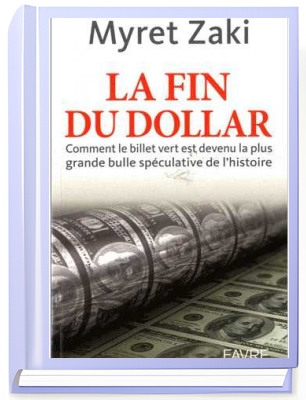
Myret Zaki, «La fin du dollar», Editions Favre, avril 2011
About the author

Nadia Sikorsky was born and raised in Moscow. She graduated from the Faculty of Journalism at Moscow State University and went on to complete her postgraduate studies there, earning a PhD in History. She spent 13 years at UNESCO, first in Paris and then in Geneva. After serving as Director of Communications at Green Cross International, founded by Mikhail Gorbachev, she launched NashaGazeta.ch in 2007, Switzerland’s first Russian-language online daily newspaper.
In 2022, Nadia Sikorsky was named to Le Temps’ Forum des 100, which brings together individuals who, in the newspaper’s view, have “significantly contributed to the success of French-speaking Switzerland”, from across public life, business, politics, science and culture.
After 18 years at the helm of NashaGazeta.ch, Nadia Sikorsky decided to devote herself to what had always held a special place in her work as a journalist: culture in all its diversity. This led to the creation of Russian Accent, a trilingual cultural blog in Russian, French and English, born in the heart of Europe, in Switzerland, which has become her second home and whose multiculturalism and multilingualism have helped shape the character of this new project.
At the heart of the project is the perspective of a European of Russian origin, drawing on more than 35 years of professional experience and a deep knowledge of both cultural traditions. Nadia Sikorsky sees her role as that of a cultural mediator between the two. The title of the blog, Russian Accent, reflects this idea: the accent is neither a linguistic barrier nor a political position, but a distinctive cultural imprint within a European context.