Roman réaliste, voire hyperréaliste, Les Eltychev raconte la déchéance et la chute d’une famille russe ordinaire. Il est vrai qu’ils ne tombent pas de très haut… Le père, Nikolaï, est policier dans le chef-lieu de la province ; sa femme, Valentina, a péniblement réussi à s’extraire de son hameau perdu. Un de leurs fils est en prison, l’autre est un bon à rien. Suite à une bavure, Nikolaï est radié de la police et doit rendre son appartement de fonction. La famille décide de partir s’installer dans le village où a grandi Valentina, à 50 kilomètres de la ville. Dans une atmosphère minée par l’alcool et l’absence de travail, les Eltychev passent l’hiver comme engourdis. Le printemps leur amènera quelques bribes d’espoir, vite envolées.
« Dans son superbe roman Les Eltychev, Roman Sentchine raconte l’agonie d’une famille russe ordinaire, oppressée par les nouvelles conditions économiques. Preuve qu’un roman peut, sur le thème de la dégradation sociale, devenir un excellent cru littéraire. » Pavel Basinski, Rossiïskaïa Gazeta
Continuant la tradition littéraire russe du XIXe siècle, Sentchine nous raconte une épopée familiale de province, la lente déchéance d’une famille russe. Dans un style simple et inexorable, l’auteur décrit la tragique réalité, marquée par la pauvreté, l’absence d’espoir et la perte des valeurs morales, de la vie dans les villages russes d’aujourd’hui. Une implacable peinture sociale de notre temps.
Roman Sentchine est né en 1971, dans la république de Touva. En 1993, sa famille doit quitter la ville et s’installe dans la région de Krasnoïarsk, dans une situation très précaire. Sentchine fait différents métiers avant de terminer des études à l’Institut de littérature en 2001. Il est considéré comme l’un des représentants du nouveau réalisme russe. Ses romans (notamment Minus, traduit en anglais et en allemand ; Informatsia, paru en 2011) ont reçu un accueil enthousiaste du public russe, et ont été récompensés par de nombreux prix littéraires.
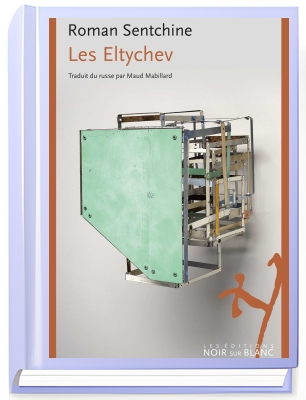
Roman Sentchine: Les Eltychev, Les Editions Noir sur Blanc, 2013
About the author

Nadia Sikorsky was born and raised in Moscow. She graduated from the Faculty of Journalism at Moscow State University and went on to complete her postgraduate studies there, earning a PhD in History. She spent 13 years at UNESCO, first in Paris and then in Geneva. After serving as Director of Communications at Green Cross International, founded by Mikhail Gorbachev, she launched NashaGazeta.ch in 2007, Switzerland’s first Russian-language online daily newspaper.
In 2022, Nadia Sikorsky was named to Le Temps’ Forum des 100, which brings together individuals who, in the newspaper’s view, have “significantly contributed to the success of French-speaking Switzerland”, from across public life, business, politics, science and culture.
After 18 years at the helm of NashaGazeta.ch, Nadia Sikorsky decided to devote herself to what had always held a special place in her work as a journalist: culture in all its diversity. This led to the creation of Russian Accent, a trilingual cultural blog in Russian, French and English, born in the heart of Europe, in Switzerland, which has become her second home and whose multiculturalism and multilingualism have helped shape the character of this new project.
At the heart of the project is the perspective of a European of Russian origin, drawing on more than 35 years of professional experience and a deep knowledge of both cultural traditions. Nadia Sikorsky sees her role as that of a cultural mediator between the two. The title of the blog, Russian Accent, reflects this idea: the accent is neither a linguistic barrier nor a political position, but a distinctive cultural imprint within a European context.