Bookshelf

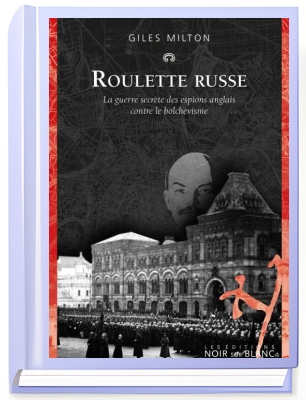
Giles Milton: Roulette russe. La guerre secrète des espions anglais contre le bolchévisme. Les Editions Noir sur Blanc

Traduit de l’anglais par Florence Hertz

1917. Au lendemain de la révolution russe, une bande d’espions britanniques entre clandestinement en Russie soviétique afin de déjouer les plans de Lénine. Le chef du Soviet suprême cherche à détruire l’hégémonie britannique en Inde, en faisant jouer ses appuis en Asie centrale ; il veut ainsi déstabiliser les démocraties occidentales et finalement les renverser. Commandé par l’excentrique Mansfield Cumming, capitaine de marine déchu et grand amateur d’encres sympathiques, le groupe d’espions anglais infiltre le pays des Soviets. Pendant trois ans, les espions explorent les cellules du Parti, l’Armée rouge et la Tcheka par tous les moyens, y compris la ruse et le meurtre. Cumming, unijambiste passionné par les explosifs, donne à ses hommes toute liberté d’agir ; son seul mot d’ordre : « Évitez de vous faire descendre ». Ils manqueront de peu d’assassiner Lénine ; finalement, ils l’empêcheront de mettre à exécution son grand projet de révolution mondiale.


Entre James Bond et Jules Verne, Giles Milton raconte les péripéties des précurseurs du Secret Intelligence Service. Un livre palpitant, mêlant fiction et réalité historique, qui plonge le lecteur dans l’atmosphère bouillonnante de la Russie révolutionnaire.

Né en 1966, Giles Milton, historien et écrivain anglais, est spécialiste de l’histoire des voyages et des explorations. Il collabore à nombre de journaux anglais et étrangers. Il a publié plusieurs ouvrages, dont six traduits en français aux Éditions Noir sur Blanc : La Guerre de la noix muscade (2000), Les Aventuriers de la Reine (2002), Samouraï William (2003), Captifs en Barbarie (2006), Le Paradis perdu (2010) et Wolfram, un jeune rêveur face aux nazis (2012), et deux romans traduits chez Buchet/Chastel, Le Nez d’Edward Trencom (2007) et Le Monde selon Arnold (2010). Il a également écrit trois livres pour enfants, dont deux illustrés par sa femme Alexandra. Il vit à Londres.


About the author

Nadia Sikorsky

Nadia Sikorsky was born and raised in Moscow. She graduated from the Faculty of Journalism at Moscow State University and went on to complete her postgraduate studies there, earning a PhD in History. She spent 13 years at UNESCO, first in Paris and then in Geneva. After serving as Director of Communications at Green Cross International, founded by Mikhail Gorbachev, she launched NashaGazeta.ch in 2007, Switzerland’s first Russian-language online daily newspaper.

In 2022, Nadia Sikorsky was named to Le Temps’ Forum des 100, which brings together individuals who, in the newspaper’s view, have “significantly contributed to the success of French-speaking Switzerland”, from across public life, business, politics, science and culture.

After 18 years at the helm of NashaGazeta.ch, Nadia Sikorsky decided to devote herself to what had always held a special place in her work as a journalist: culture in all its diversity. This led to the creation of Russian Accent, a trilingual cultural blog in Russian, French and English, born in the heart of Europe, in Switzerland, which has become her second home and whose multiculturalism and multilingualism have helped shape the character of this new project.

At the heart of the project is the perspective of a European of Russian origin, drawing on more than 35 years of professional experience and a deep knowledge of both cultural traditions. Nadia Sikorsky sees her role as that of a cultural mediator between the two. The title of the blog, Russian Accent, reflects this idea: the accent is neither a linguistic barrier nor a political position, but a distinctive cultural imprint within a European context.

Events
Most read

A new book by the Geneva-based Slavist Jean-Philippe Jaccard and his Russian colleague Andrei Ustinov, now living in San Francisco, has been published by the European University at St Petersburg: Vzir Zaumi. Daniil Harms and the Literary Avant-Garde of the 1920s. In the authors' own words, the volume offers a kind of X-ray of Leningrad's "left-wing " circles and their evolution during the period between Harms's poetic debut and the creation of OBERIU, as well as the dynamics that shaped those circles.

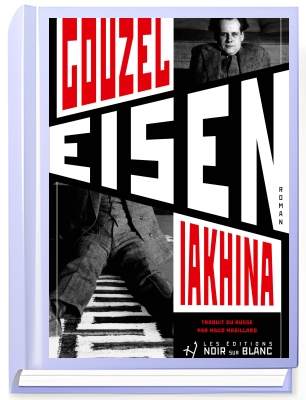
A few days ago, the Lausanne-based publisher Éditions Noir sur Blanc brought out Guzel Yakhina’s novel about the celebrated Soviet film director Sergei Eisenstein. French readers will be able to read it in Maud Mabillard’s translation and, importantly, in full, including the ninth chapter omitted from the Russian edition.