Un voyage extatique en train dans la lumière flamboyante des Alpes-Maritimes, des réflexions en filigrane sur la Russie passée et présente, une sordide affaire de meurtre ou l’histoire d’amour tragique entre un officier et une actrice : ces nouvelles, inédites pour la plupart, sont rédigées entre 1925 et 1926 en France, où l’auteur a trouvé refuge.
La force poétique qui se dégage de ce recueil rend le réel magique. On retrouve chez Bounine des personnages passionnés, qui vivent aussi intensément le bonheur que la peur, la foi que le désespoir sans issue. Et la douce musique de la nostalgie relie l’auteur « d’un lien tendre et pieux à sa lignée, au monde lointain et plein de charme » de sa jeunesse et de son pays perdu.
Coup de soleil, la nouvelle qui donne son titre au recueil, relate la rencontre passionnée et furtive sur la Volga de deux inconnus. C’est l’éloge de la fulgurance et de l’incandescence des sentiments. Quant à Sur les eaux immenses, c’est une merveilleuse invitation au voyage aux accents quasiment baudelairiens.
Poète, prosateur et essayiste, Ivan Bounine (1870-1953) est une figure de proue des lettres russes de sa génération et le premier écrivain russe à avoir reçu le prix Nobel de littérature (1933). Antibolchevique, Bounine quitte la Russie soviétique en 1920 et s’installe à Paris où il devient une figure marquante de l’émigration russe. Auteur du Calice de la vie (1913), du Monsieur de San Francisco (1915) ou de La Vie d’Arseniev (1930), il est un classique, dans la lignée de Tolstoï ou de Tourgueniev.
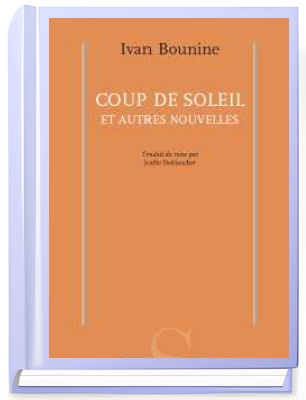
Ivan BOUNINE : Coup de soleil et autres nouvelles. Editions des Syrtes, 2014
About the author

Nadia Sikorsky was born and raised in Moscow. She graduated from the Faculty of Journalism at Moscow State University and went on to complete her postgraduate studies there, earning a PhD in History. She spent 13 years at UNESCO, first in Paris and then in Geneva. After serving as Director of Communications at Green Cross International, founded by Mikhail Gorbachev, she launched NashaGazeta.ch in 2007, Switzerland’s first Russian-language online daily newspaper.
In 2022, Nadia Sikorsky was named to Le Temps’ Forum des 100, which brings together individuals who, in the newspaper’s view, have “significantly contributed to the success of French-speaking Switzerland”, from across public life, business, politics, science and culture.
After 18 years at the helm of NashaGazeta.ch, Nadia Sikorsky decided to devote herself to what had always held a special place in her work as a journalist: culture in all its diversity. This led to the creation of Russian Accent, a trilingual cultural blog in Russian, French and English, born in the heart of Europe, in Switzerland, which has become her second home and whose multiculturalism and multilingualism have helped shape the character of this new project.
At the heart of the project is the perspective of a European of Russian origin, drawing on more than 35 years of professional experience and a deep knowledge of both cultural traditions. Nadia Sikorsky sees her role as that of a cultural mediator between the two. The title of the blog, Russian Accent, reflects this idea: the accent is neither a linguistic barrier nor a political position, but a distinctive cultural imprint within a European context.