Bookshelf

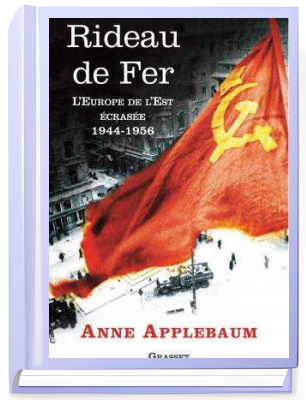
Anne Applebaum: Rideau de fer, l'Europe de l'Est ecrasée. Bernard Grasset, Paris, 2014.

Traduit de l'anglais par Pierre-Emmanuel Dauzat. L'édition originale de cet ouvrage a été publiée en 2012 par Doubleday, a division of Random House Inc., sous le titre "Iron Curtain/the Crushing of Eastern Europe, 1944-1956".

Il y a deux manières de renouveler l’Histoire : poser de nouvelles questions sur des sujets apparemment rebattus et trouver de nouveaux documents ou de nouveaux témoins.

Dans ce livre magistral, Anne Applebaum accomplit les deux.

S’interrogeant sur le « Haut Stalinisme » (1944-1956), soit les douze années de soviétisation de l’ancien Lebensraum nazi (en se concentrant essentiellement sur trois pays emblématiques : Allemagne, Hongrie et Pologne), l’auteur renverse complètement le point de vue : non plus l’Est vu par l’Ouest mais l’Est vu par l’Est. Les sources archivistiques et orales inédites – lectures dans au moins cinq langues, entretiens, voyages, témoignages personnels – enrichissent considérablement les réponses aux questions que l’observateur contemporain de l’Europe de l’Est se pose face aux échecs ou aux revers de la démocratisation des nouvelles nations émancipées du joug soviétique depuis 1989.

Rideau de fer prend exactement la suite chronologique de l’ouvrage de Timothy Snyder, Terres de sang, consacré au nazisme et au stalinisme de 1933 à 1945 : il raconte, comme cela n’avait jamais été fait, la manière dont ces « terres de sang » ont été soviétisées (réparations économiques, nettoyages ethniques systématiques que l’on associe rarement à cette période de l’Histoire, récupération partielle de l’appareil policier hérité du nazisme, etc.).

Ce grand livre a été unanimement salué comme un des chefs-d’œuvre de l’Histoire récente.

L'historien André Liebich propose sa vision de cet ouvrage.

About the author

Nadia Sikorsky

Nadia Sikorsky was born and raised in Moscow. She graduated from the Faculty of Journalism at Moscow State University and went on to complete her postgraduate studies there, earning a PhD in History. She spent 13 years at UNESCO, first in Paris and then in Geneva. After serving as Director of Communications at Green Cross International, founded by Mikhail Gorbachev, she launched NashaGazeta.ch in 2007, Switzerland’s first Russian-language online daily newspaper.

In 2022, Nadia Sikorsky was named to Le Temps’ Forum des 100, which brings together individuals who, in the newspaper’s view, have “significantly contributed to the success of French-speaking Switzerland”, from across public life, business, politics, science and culture.

After 18 years at the helm of NashaGazeta.ch, Nadia Sikorsky decided to devote herself to what had always held a special place in her work as a journalist: culture in all its diversity. This led to the creation of Russian Accent, a trilingual cultural blog in Russian, French and English, born in the heart of Europe, in Switzerland, which has become her second home and whose multiculturalism and multilingualism have helped shape the character of this new project.

At the heart of the project is the perspective of a European of Russian origin, drawing on more than 35 years of professional experience and a deep knowledge of both cultural traditions. Nadia Sikorsky sees her role as that of a cultural mediator between the two. The title of the blog, Russian Accent, reflects this idea: the accent is neither a linguistic barrier nor a political position, but a distinctive cultural imprint within a European context.

Events
Most read

A new book by the Geneva-based Slavist Jean-Philippe Jaccard and his Russian colleague Andrei Ustinov, now living in San Francisco, has been published by the European University at St Petersburg: Vzir Zaumi. Daniil Harms and the Literary Avant-Garde of the 1920s. In the authors' own words, the volume offers a kind of X-ray of Leningrad's "left-wing " circles and their evolution during the period between Harms's poetic debut and the creation of OBERIU, as well as the dynamics that shaped those circles.

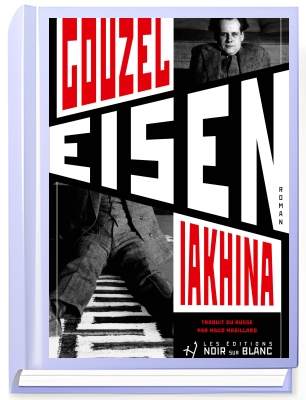
A few days ago, the Lausanne-based publisher Éditions Noir sur Blanc brought out Guzel Yakhina’s novel about the celebrated Soviet film director Sergei Eisenstein. French readers will be able to read it in Maud Mabillard’s translation and, importantly, in full, including the ninth chapter omitted from the Russian edition.