Bookshelf

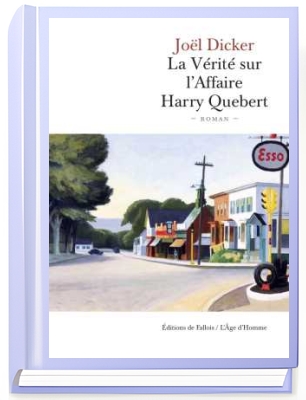
Joel Dicker: La Vérité sur l’Affaire Harry Quebert. Editions de Fallois / Age d’Homme

GRAND PRIX DU ROMAN DE L’ACADEMIE FRANCAISE 2012 ! GONCOURT DES LYCEENS 2012 PRIX DE LA VOCATION DE LA FONDATION BLEUSTEIN-BLANCHET 2012

À New York, au printemps 2008, alors que l’Amérique bruisse des prémices de l’élection présidentielle, Marcus Goldman, jeune écrivain à succès, est dans la tourmente : il est incapable d’écrire le nouveau roman qu’il doit remettre à son éditeur d’ici quelques mois.

Le délai est près d’expirer quand soudain tout bascule pour lui  : son ami et ancien professeur d’université, Harry Quebert, l’un des écrivains les plus respectés du pays, est rattrapé par son passé et se retrouve accusé d’avoir assassiné, en 1975, Nola Kellergan, une jeune fille avec qui il aurait eu une liaison. Convaincu de l’innocence de Harry, Marcus abandonne tout pour se rendre dans le New Hampshire et mener son enquête. Il est rapidement dépassé par les événe- ments : l’enquête s’enfonce et il fait l’objet de menaces. Pour innocenter Harry et sauver sa carrière d’écrivain, il doit absolument répondre à trois questions : Qui a tué Nola Kellergan ? Que s’est-il passé dans le New Hampshire à l’été 1975 ? Et comment écrit-on un roman à succès ?

Sous ses airs de thriller à l’américaine, La Vérité sur l’Affaire Harry Quebert est une réflexion sur l’Amérique, sur les travers de la société moderne, sur la littérature, sur la justice et sur les médias.


A propos de ce livre…


« Surtout soyez ambitieux ! » La scène se passe dans l’arrière-salle de la Librairie du Rameau d’Or, à Genève, là où Vladimir Dimitrijevic, légendaire patron des éditions L’Age d’Homme, tient séance tous les samedis. C’est au début de l’année 2011. Quelques semaines plus tôt, Vladimir Dimitrijevic m’a proposé de publier mon premier roman « Les derniers jours de nos pères ». Depuis, je ne cesse de venir le voir pour lui demander « Quand ? » « Comment ? » et toutes ces questions légitimes qui tracassent ceux qui vont voir un de leur texte prendre vie sous forme de livre. Ce jour-là, il me prie de cesser mon cirque du samedi et de ne pas m’inquiéter :

– J’ai édité plus de 4’000 titres dans ma vie, me dit-il. Et vous ? Combien en avez-vous édité ?

– Heu… zéro.

Рецензию Андрея Геласимова читайте здесь.

About the author

Nadia Sikorsky

Nadia Sikorsky was born and raised in Moscow. She graduated from the Faculty of Journalism at Moscow State University and went on to complete her postgraduate studies there, earning a PhD in History. She spent 13 years at UNESCO, first in Paris and then in Geneva. After serving as Director of Communications at Green Cross International, founded by Mikhail Gorbachev, she launched NashaGazeta.ch in 2007, Switzerland’s first Russian-language online daily newspaper.

In 2022, Nadia Sikorsky was named to Le Temps’ Forum des 100, which brings together individuals who, in the newspaper’s view, have “significantly contributed to the success of French-speaking Switzerland”, from across public life, business, politics, science and culture.

After 18 years at the helm of NashaGazeta.ch, Nadia Sikorsky decided to devote herself to what had always held a special place in her work as a journalist: culture in all its diversity. This led to the creation of Russian Accent, a trilingual cultural blog in Russian, French and English, born in the heart of Europe, in Switzerland, which has become her second home and whose multiculturalism and multilingualism have helped shape the character of this new project.

At the heart of the project is the perspective of a European of Russian origin, drawing on more than 35 years of professional experience and a deep knowledge of both cultural traditions. Nadia Sikorsky sees her role as that of a cultural mediator between the two. The title of the blog, Russian Accent, reflects this idea: the accent is neither a linguistic barrier nor a political position, but a distinctive cultural imprint within a European context.

Events
Most read

A new book by the Geneva-based Slavist Jean-Philippe Jaccard and his Russian colleague Andrei Ustinov, now living in San Francisco, has been published by the European University at St Petersburg: Vzir Zaumi. Daniil Harms and the Literary Avant-Garde of the 1920s. In the authors' own words, the volume offers a kind of X-ray of Leningrad's "left-wing " circles and their evolution during the period between Harms's poetic debut and the creation of OBERIU, as well as the dynamics that shaped those circles.

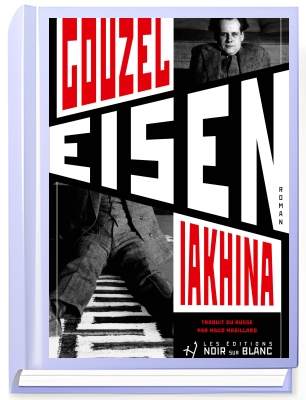
A few days ago, the Lausanne-based publisher Éditions Noir sur Blanc brought out Guzel Yakhina’s novel about the celebrated Soviet film director Sergei Eisenstein. French readers will be able to read it in Maud Mabillard’s translation and, importantly, in full, including the ninth chapter omitted from the Russian edition.