Une âme douce est une interrogation sur le théâtre de Tchekhov et sur la littérature, sa place dans la vie et sa dimension éthique. La Cerisaie et La Mouette sont encore aujourd’hui deux des pièces les plus populaires du répertoire dramaturgique mondial. Grand amoureux du théâtre, Alexandre Minkine cherche à renouveler la lecture des œuvres de Tchekhov en les débarrassant des innombrables strates de commentaires qui pèsent sur leur réception.
La lecture de La Cerisaie se distingue ainsi des interprétations traditionnelles où Lopakhine est vu comme un marchand parvenu, un moujik manquant d'élégance. Pour Alexandre Minkine, Lopakhine est le personnage central de la pièce car c'est Tchekhov lui-même. Beaucoup d'éléments les rapprochent: origine modeste, père tyrannique, vie sentimentale malheureuse, achat d'une propriété. Pour Minkine, La Cerisaie (écrite par Tchekhov un an avant sa mort) est un récit sur Tchekhov lui-même.
Selon Minkine, dans La Mouette, tous les événements importants ont lieu dans les coulisses comme la chute de l’innocente Nina. C’est seulement à l’approche du final qu’on entend le mot « liaison ». C’est aussi dans les coulisses que naît et meurt l’enfant qu’elle eut de Trigorine.
Minkine s’interroge également sur la place occupée par Tchekhov dans le théâtre mondial. Pourquoi il demeure si populaire, le deuxième dramaturge le plus lu et joué après Shakespeare? Et il observe une similitude avec Maupassant (notamment avec la nouvelle Sur l’eau): « Maupassant est un génie ! Lisez Maupassant ! » dit un des personnages.
Ces textes forment dans un ensemble cohérent une interrogation sur la littérature, sur sa place dans la vie et sa dimension éthique. L’auteur cherche à renouveler la lecture du théâtre tchékhovien par un retour aux indications scéniques, une prise en compte des intentions de l’auteur. Le lecteur y découvrira un Tchekhov simple, proche, revitalisé et une approche sensible de son théâtre. Une âme douce est une déclaration d’amour de l’auteur à la littérature et à la langue russes.
Alexandre Minkine est diplômé de la prestigieuse école de théâtre moscovite GITIS. Il s'est tourné ensuite vers le journalisme, comme analyste politique du très populaire quotidien "Moskovski komsomolets", certains de ses articles ont conduit à la démission de personnalités politiques.
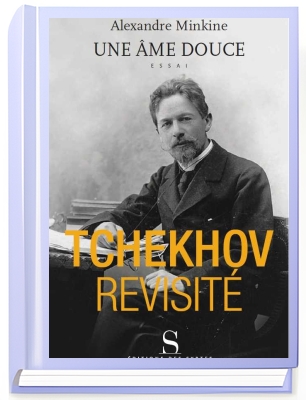
Alexandre MINKINE: Une âme douce, Editions Syrtes, 2014
About the author

Nadia Sikorsky was born and raised in Moscow. She graduated from the Faculty of Journalism at Moscow State University and went on to complete her postgraduate studies there, earning a PhD in History. She spent 13 years at UNESCO, first in Paris and then in Geneva. After serving as Director of Communications at Green Cross International, founded by Mikhail Gorbachev, she launched NashaGazeta.ch in 2007, Switzerland’s first Russian-language online daily newspaper.
In 2022, Nadia Sikorsky was named to Le Temps’ Forum des 100, which brings together individuals who, in the newspaper’s view, have “significantly contributed to the success of French-speaking Switzerland”, from across public life, business, politics, science and culture.
After 18 years at the helm of NashaGazeta.ch, Nadia Sikorsky decided to devote herself to what had always held a special place in her work as a journalist: culture in all its diversity. This led to the creation of Russian Accent, a trilingual cultural blog in Russian, French and English, born in the heart of Europe, in Switzerland, which has become her second home and whose multiculturalism and multilingualism have helped shape the character of this new project.
At the heart of the project is the perspective of a European of Russian origin, drawing on more than 35 years of professional experience and a deep knowledge of both cultural traditions. Nadia Sikorsky sees her role as that of a cultural mediator between the two. The title of the blog, Russian Accent, reflects this idea: the accent is neither a linguistic barrier nor a political position, but a distinctive cultural imprint within a European context.