Bookshelf

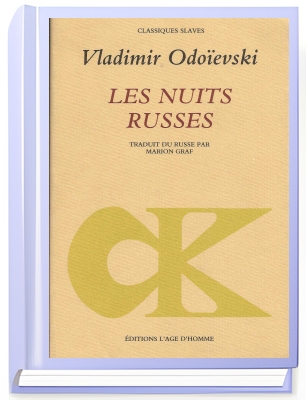
Vladimir Odoïevski: Les nuits russes. Editions L'Age d'Homme

Traduit du russe par Marion Graf.

Les temps qu’avaient annoncés les philosophes du XIXéme  siècle arrivèrent, la race humaine s’était multipliée, entre les produits de la nature et les besoins de l’humanité. L’équilibre était rompu, lentement, inexorablement, la catastrophe approchait. Chassés par la misère, les habitants des villes fuyaient dans les campagnes, les champs se transformaient en villages, les villages en villes et les villes s’étendaient peu à peu; c’est en vain que les hommes avaient mis en œuvre toute la science acquise à la sueur des siècles, en vain qu’aux expédients de l’art, ils avaient allié une activité intense, accrue par la nécessité vitale. Depuis longtemps déjà, les déserts d’Arabie étaient devenus de gras pâturages, depuis longtemps, un humus fertile recouvrait les glaces du Nord, grâce aux efforts prodigieux de la chimie, une chaleur artificielle vivifiait le royaume du froid éternel mais tout cela en pure perte?

Pourquoi l’essor des sciences et des techniques n’a-t-il pas apporté le bonheur à l’humanité? A partir de cette question, les personnages des Nuits russes s’engagent dans un débat passionné, d’une acuité souvent prophétique, qui se prolonge durant neuf nuits. L’auteur se méfie du monologue philosophique, c’est pourquoi, à la manière d’un organiste, il utilise successivement divers registres, juxtapose avec finesse et ironie des genres littéraires contrastés. Une démarche soucieuse de sa globalité, suggestive autant qu’intellectuelle, rebelle à tout cloisonnement, où Piranèse côtoie bach, Beethoven, les alchimistes, Malthus et Adam Smith, où la réflexion relaie la fiction, où le dialogue et l’emphase ont leur place, sans pour autant que soit oublié le silencieux message de l’aurore.

Philosophe,musicologue, conteur, polémiste et homme d’esprit, le Prince Odoïevski (1803-1869) fut l’un des principaux acteurs du Romantisme russe, dont son roman philosophique Les Nuits russes est une œuvre majeure et unique dans son genre.

L'interview avec Marion Graf à lire ici.

About the author

Nadia Sikorsky

Nadia Sikorsky was born and raised in Moscow. She graduated from the Faculty of Journalism at Moscow State University and went on to complete her postgraduate studies there, earning a PhD in History. She spent 13 years at UNESCO, first in Paris and then in Geneva. After serving as Director of Communications at Green Cross International, founded by Mikhail Gorbachev, she launched NashaGazeta.ch in 2007, Switzerland’s first Russian-language online daily newspaper.

In 2022, Nadia Sikorsky was named to Le Temps’ Forum des 100, which brings together individuals who, in the newspaper’s view, have “significantly contributed to the success of French-speaking Switzerland”, from across public life, business, politics, science and culture.

After 18 years at the helm of NashaGazeta.ch, Nadia Sikorsky decided to devote herself to what had always held a special place in her work as a journalist: culture in all its diversity. This led to the creation of Russian Accent, a trilingual cultural blog in Russian, French and English, born in the heart of Europe, in Switzerland, which has become her second home and whose multiculturalism and multilingualism have helped shape the character of this new project.

At the heart of the project is the perspective of a European of Russian origin, drawing on more than 35 years of professional experience and a deep knowledge of both cultural traditions. Nadia Sikorsky sees her role as that of a cultural mediator between the two. The title of the blog, Russian Accent, reflects this idea: the accent is neither a linguistic barrier nor a political position, but a distinctive cultural imprint within a European context.

Events
Most read

A new book by the Geneva-based Slavist Jean-Philippe Jaccard and his Russian colleague Andrei Ustinov, now living in San Francisco, has been published by the European University at St Petersburg: Vzir Zaumi. Daniil Harms and the Literary Avant-Garde of the 1920s. In the authors' own words, the volume offers a kind of X-ray of Leningrad's "left-wing " circles and their evolution during the period between Harms's poetic debut and the creation of OBERIU, as well as the dynamics that shaped those circles.

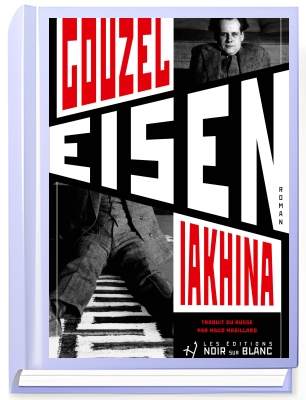
A few days ago, the Lausanne-based publisher Éditions Noir sur Blanc brought out Guzel Yakhina’s novel about the celebrated Soviet film director Sergei Eisenstein. French readers will be able to read it in Maud Mabillard’s translation and, importantly, in full, including the ninth chapter omitted from the Russian edition.