En mars 1994, Claude Marthaler quitte la Suisse à vélo dans le but de rejoindre le Japon deux années plus tard.
Il fait partie des premiers Européens à traverser seul l'ex-URSS qui vient à peine de s'ouvrir au tourisme individuel, avant de gagner les hauts plateaux tibétains qu'il sillonne longuement. Au chant des roues de son vélo, il se laisse gagner par l'ivresse de l'aventure et, en 1997, s'envole du Japon pour l'Alaska. Il pédale jusqu'à l'océan Arctique et repart vers le Sud par les Montagnes Rocheuses et la cordillère des Andes, atteignant Ushuaia en mars 1999.
Puis, il prend l'avion pour Le Cap d'où il remonte toute l'Afrique, traversant le Congo démocratique en pleine guerre et le désert du Sahara par la Mauritanie. Il boucle finalement son tour du monde en juin 2001, au terme de sept années, ayant parcouru 122 000 km et visité 60 pays. Les régions traversées n'ont pas été choisies pour leur facilité : les plus hautes pistes du monde, les déserts les plus arides et les hivers les plus rigoureux...
Au-delà de l'exploit physique que représente son périple, Claude Marthaler nous restitue d'une manière très vivante son mode de vie nomade et solitaire. Il met en évidence avec beaucoup d'humanité ses contacts chaleureux avec les populations, la découverte des différentes cultures, mais aussi comment il a surmonté les obstacles administratifs, par exemple en " prolongeant ", lui-même son visa en URSS, ou en prenant les pédales à son cou pour échapper à la police chinoise...
Bookshelf
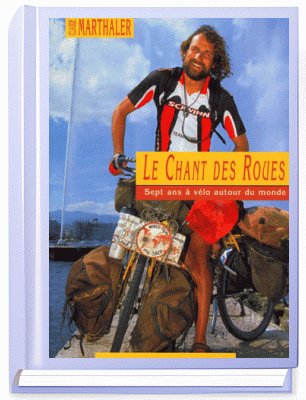
Claude Marthaler: Le chant des roues, 7 ans à vélo autour du monde. Editions Olizane, 2002
About the author

Nadia Sikorsky was born and raised in Moscow. She graduated from the Faculty of Journalism at Moscow State University and went on to complete her postgraduate studies there, earning a PhD in History. She spent 13 years at UNESCO, first in Paris and then in Geneva. After serving as Director of Communications at Green Cross International, founded by Mikhail Gorbachev, she launched NashaGazeta.ch in 2007, Switzerland’s first Russian-language online daily newspaper.
In 2022, Nadia Sikorsky was named to Le Temps’ Forum des 100, which brings together individuals who, in the newspaper’s view, have “significantly contributed to the success of French-speaking Switzerland”, from across public life, business, politics, science and culture.
After 18 years at the helm of NashaGazeta.ch, Nadia Sikorsky decided to devote herself to what had always held a special place in her work as a journalist: culture in all its diversity. This led to the creation of Russian Accent, a trilingual cultural blog in Russian, French and English, born in the heart of Europe, in Switzerland, which has become her second home and whose multiculturalism and multilingualism have helped shape the character of this new project.
At the heart of the project is the perspective of a European of Russian origin, drawing on more than 35 years of professional experience and a deep knowledge of both cultural traditions. Nadia Sikorsky sees her role as that of a cultural mediator between the two. The title of the blog, Russian Accent, reflects this idea: the accent is neither a linguistic barrier nor a political position, but a distinctive cultural imprint within a European context.
Events