Bookshelf

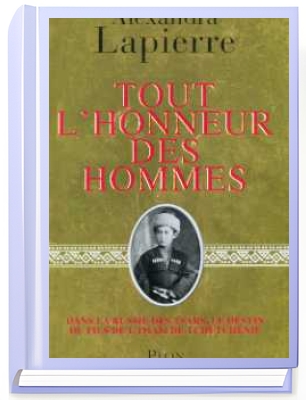
Alexandra Lapierre : Tout l’honneur des hommes, Eds. Plon, 2008

La bouleversante histoire d’un homme d’honneur pris en otage entre deux cultures et deux fidélités.

En 1839, au cœur des montagnes du Caucase, les cavaliers musulmans de l’Imam Shamil résistent à l’invasion des puissantes armées du tsar Nicolas Ier. Contraints de négocier avec les Russes, ils leur remettent le fils aîné de l’Imam, Djemmal-Eddin, garant de leur bonne foi durant les pourparlers de paix.
Le petit garçon, à peine âgé de huit ans, sera obligatoirement rendu à son père une fois les accords signés.

Mais les Russes, au mépris des traditions, de la parole donnée et du code de l’honneur, l’enlèvent et l’expédient de force à Saint-Pétersbourg.
L’enfant y connaît une vie d’angoisses et de déchirures, de doutes et de découvertes. Le Tsar, touché par sa dignité, le fait instruire à la cour avec ses propres fils. Djemmal-Eddin devient un lettré, peintre, musicien, excellent officier. Cependant, il ne renie pas ses origines et reste fidèle à l’Islam.
Jusqu’au jour où il tombe amoureux…

Construit comme un roman d’aventures, mais fondé sur une impeccable documentation, « Tout l’honneur des hommes » est le récit d’une histoire vraie qui met en scène des personnages d’une immense envergure.

De la résistance tchétchène… aux ors du palais d’Hiver.
Des appels du muezzin… aux valses de Glinka.
Des farouches cavaliers du Caucase… aux charmes des princesses russes.

Alexandra Lapierre a enquêté durant trois ans dans es bibliothèques de Moscou et de Saint-Pétersbourg. Elle a fouillé les fonds d’archives dans les petites villes de Russie, poursuivi son héros jusque dans les villages de Géorgie et les montagnes du Caucase.
Alliant le souffle de l’aventure au sérieux de la recherche universitaire, ses livres ressuscitent les grandes figures oubliées par l’Histoire et sont traduits dans le monde entier. Elle est notamment l’auteur de Fanny Stevenson « Grand Prix des lectrices de ELLE » ; et d’Artemisia, couronné en Sorbonne par « Le Prix du XVIIe siècle ». La qualité de l’écriture et la force d’évocation font de son nouveau roman une épopée qui jette une lumière fulgurante sur tous les conflits dans cette mystérieuse partie du monde.


About the author

Nadia Sikorsky

Nadia Sikorsky was born and raised in Moscow. She graduated from the Faculty of Journalism at Moscow State University and went on to complete her postgraduate studies there, earning a PhD in History. She spent 13 years at UNESCO, first in Paris and then in Geneva. After serving as Director of Communications at Green Cross International, founded by Mikhail Gorbachev, she launched NashaGazeta.ch in 2007, Switzerland’s first Russian-language online daily newspaper.

In 2022, Nadia Sikorsky was named to Le Temps’ Forum des 100, which brings together individuals who, in the newspaper’s view, have “significantly contributed to the success of French-speaking Switzerland”, from across public life, business, politics, science and culture.

After 18 years at the helm of NashaGazeta.ch, Nadia Sikorsky decided to devote herself to what had always held a special place in her work as a journalist: culture in all its diversity. This led to the creation of Russian Accent, a trilingual cultural blog in Russian, French and English, born in the heart of Europe, in Switzerland, which has become her second home and whose multiculturalism and multilingualism have helped shape the character of this new project.

At the heart of the project is the perspective of a European of Russian origin, drawing on more than 35 years of professional experience and a deep knowledge of both cultural traditions. Nadia Sikorsky sees her role as that of a cultural mediator between the two. The title of the blog, Russian Accent, reflects this idea: the accent is neither a linguistic barrier nor a political position, but a distinctive cultural imprint within a European context.

Events
Most read

A new book by the Geneva-based Slavist Jean-Philippe Jaccard and his Russian colleague Andrei Ustinov, now living in San Francisco, has been published by the European University at St Petersburg: Vzir Zaumi. Daniil Harms and the Literary Avant-Garde of the 1920s. In the authors' own words, the volume offers a kind of X-ray of Leningrad's "left-wing " circles and their evolution during the period between Harms's poetic debut and the creation of OBERIU, as well as the dynamics that shaped those circles.

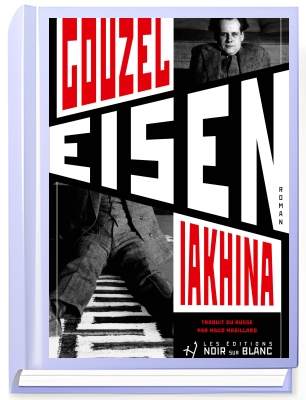
A few days ago, the Lausanne-based publisher Éditions Noir sur Blanc brought out Guzel Yakhina’s novel about the celebrated Soviet film director Sergei Eisenstein. French readers will be able to read it in Maud Mabillard’s translation and, importantly, in full, including the ninth chapter omitted from the Russian edition.