Bookshelf

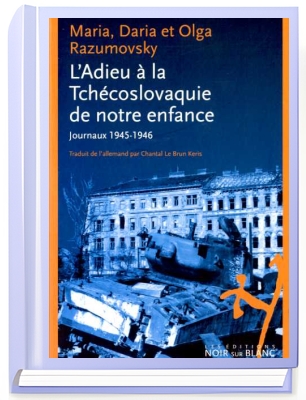
Maria, Daria et Olga Razumovsky: L'Adieu à la Tchécoslovaquie de notre enfance. Les Editions Noir sur Blanc, 2009

Titre original: Unser Abschied von der tschechischen Heimat. Tagebücher 1945-1946. Böhlau Verlag GmbH & Co. KG, Wien, 2000. Traduit de l'allemand par Chantal Le Brun Keris.

Maria (Macha), née en 1923, Daria (Dolly), née en 1925 et Olga (née en 1927, les trois filles de comte Razumovsky, commencent à tenir leurs journaux intimes au début de la guerre. le premier volume, Nos journaux cachés (Noir sur Blanc, 2004), traitait des années 1938 à 1944. Maria Razumovsky est aussi l'auteur de Marina Tsvetaieva, Mythe et réalité, et de Les Razumovsky (1730-1815). La saga d'une famille dans la Russie des tsars (parus chez Noir sur Blanc en 1988 et 1999).

Dans ces journaux croisés, écrits entre 1945 et 1946 et publiés maintenant en français, les trois souers Razumovsky nous font partager leur quotidien durant le dénouement de la querre. Depuis le château de Schönstein, au coeur de la Silésie tchèque, elles restent suspendues à leur poste de radio pour suivre l'avancée des troupes soviétiques et la débâcle des troupes allemandes. Cependant, la vie continue: il faut gérer le domaine et maintenir de bonne relations avec le village. On tente de s'évader dans la musique, tant que la radio fonctionne encore.

C'est l'attente. On attend les nouvelles du front, qui se rapproche: on attend la fin des hostilités. on attend les Soviétiques, on attend l'expropriation, on attend les titres de voyage, on attend le départ pour Vienne.

Les trois jeunes filles s'inquiètent de la brutalité de l'occupation russe, mais aussi pour l'avenir de leur famille. leur mère, une aristocrate russe, a fui la révolution bolchevique de 1917; leur père, le compte Razumovsky, est autrichien. De langue allemande, la famille risque 'être assimilée paer les "nouveaux" Tchèque communistes aux Allemands des Sudètes, fidèles alliés des nazis. C'est bien ce qui se passe: les Razumovsky sont expulsés et contraints de partir à Vienne et d'abandonner leur propriété à jamais. Pour les trois soeurs, l'adieu au pays et aux terrains e jeux de leur enfance est douloureux. Il marque aussi le début d'une vie nouvelles.


About the author

Nadia Sikorsky

Nadia Sikorsky was born and raised in Moscow. She graduated from the Faculty of Journalism at Moscow State University and went on to complete her postgraduate studies there, earning a PhD in History. She spent 13 years at UNESCO, first in Paris and then in Geneva. After serving as Director of Communications at Green Cross International, founded by Mikhail Gorbachev, she launched NashaGazeta.ch in 2007, Switzerland’s first Russian-language online daily newspaper.

In 2022, Nadia Sikorsky was named to Le Temps’ Forum des 100, which brings together individuals who, in the newspaper’s view, have “significantly contributed to the success of French-speaking Switzerland”, from across public life, business, politics, science and culture.

After 18 years at the helm of NashaGazeta.ch, Nadia Sikorsky decided to devote herself to what had always held a special place in her work as a journalist: culture in all its diversity. This led to the creation of Russian Accent, a trilingual cultural blog in Russian, French and English, born in the heart of Europe, in Switzerland, which has become her second home and whose multiculturalism and multilingualism have helped shape the character of this new project.

At the heart of the project is the perspective of a European of Russian origin, drawing on more than 35 years of professional experience and a deep knowledge of both cultural traditions. Nadia Sikorsky sees her role as that of a cultural mediator between the two. The title of the blog, Russian Accent, reflects this idea: the accent is neither a linguistic barrier nor a political position, but a distinctive cultural imprint within a European context.

Events
Most read

A new book by the Geneva-based Slavist Jean-Philippe Jaccard and his Russian colleague Andrei Ustinov, now living in San Francisco, has been published by the European University at St Petersburg: Vzir Zaumi. Daniil Harms and the Literary Avant-Garde of the 1920s. In the authors' own words, the volume offers a kind of X-ray of Leningrad's "left-wing " circles and their evolution during the period between Harms's poetic debut and the creation of OBERIU, as well as the dynamics that shaped those circles.

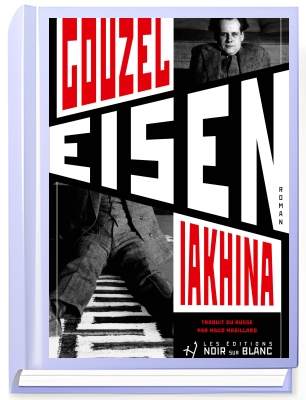
A few days ago, the Lausanne-based publisher Éditions Noir sur Blanc brought out Guzel Yakhina’s novel about the celebrated Soviet film director Sergei Eisenstein. French readers will be able to read it in Maud Mabillard’s translation and, importantly, in full, including the ninth chapter omitted from the Russian edition.