Bookshelf

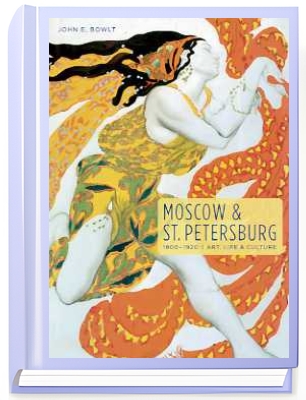
John E. Bowlt: Moscow & St. Petersburg 1900-1920. Art, Life & Culture of the Russian Silver Age. the Vendome Press, 2008

Known in Russia as the Silver Age, this cultural renaissance is captured in all of its dazzling originality in this impeccably written, sumptuously illustrated volume.

Advancing in roughly chronological sequence, Moscow & St. Petersburg 1900-1920 develops themes and propositions that relate closely - but not exclusively - to key social and political development in Russian history, which were both refracted and affected by paiting, poetry, music, and dance. With some 650 illustrations, the book carries a rich repertoire of srtistic images and vintage documentary photographs, many of which have not been previously published. With a clear, authoritative text, helpful glossary, and extensive bibliography, this book appeals both to the specialist and to anyone captivated by Russian history and culture.

John E. Bowlt is a specialist in Russian art history of the late nineteenth and early twentieth centuries, and has published widely on Symbolism, the avant-garde, and Socialist Realism. His previous books include Russian Art of the Avant-Garde: Theory and Criticism 1902-34, The Silver Age:Russian Art of the Early Twentieth Century and the "World of Art" Group, and Amazons of the Avant-Garde: Alexandra Exter, Natalia Goncharova, Liubov Popova, Olga Rozanova, Varvara Stepanova, and Nadezhda Udaltsova. Bowlt has curated and co-curated numerous exhibitions. He is currently a professor in the Department of Slavic Languages and Literatures at the University of Southern California in Los Angeles. 

About the author

Nadia Sikorsky

Nadia Sikorsky was born and raised in Moscow. She graduated from the Faculty of Journalism at Moscow State University and went on to complete her postgraduate studies there, earning a PhD in History. She spent 13 years at UNESCO, first in Paris and then in Geneva. After serving as Director of Communications at Green Cross International, founded by Mikhail Gorbachev, she launched NashaGazeta.ch in 2007, Switzerland’s first Russian-language online daily newspaper.

In 2022, Nadia Sikorsky was named to Le Temps’ Forum des 100, which brings together individuals who, in the newspaper’s view, have “significantly contributed to the success of French-speaking Switzerland”, from across public life, business, politics, science and culture.

After 18 years at the helm of NashaGazeta.ch, Nadia Sikorsky decided to devote herself to what had always held a special place in her work as a journalist: culture in all its diversity. This led to the creation of Russian Accent, a trilingual cultural blog in Russian, French and English, born in the heart of Europe, in Switzerland, which has become her second home and whose multiculturalism and multilingualism have helped shape the character of this new project.

At the heart of the project is the perspective of a European of Russian origin, drawing on more than 35 years of professional experience and a deep knowledge of both cultural traditions. Nadia Sikorsky sees her role as that of a cultural mediator between the two. The title of the blog, Russian Accent, reflects this idea: the accent is neither a linguistic barrier nor a political position, but a distinctive cultural imprint within a European context.

Events
Most read

A new book by the Geneva-based Slavist Jean-Philippe Jaccard and his Russian colleague Andrei Ustinov, now living in San Francisco, has been published by the European University at St Petersburg: Vzir Zaumi. Daniil Harms and the Literary Avant-Garde of the 1920s. In the authors' own words, the volume offers a kind of X-ray of Leningrad's "left-wing " circles and their evolution during the period between Harms's poetic debut and the creation of OBERIU, as well as the dynamics that shaped those circles.

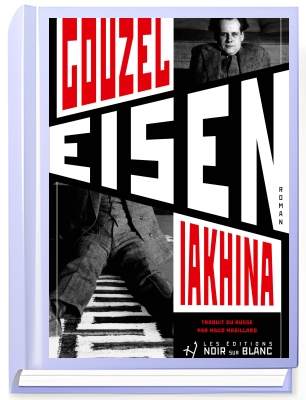
A few days ago, the Lausanne-based publisher Éditions Noir sur Blanc brought out Guzel Yakhina’s novel about the celebrated Soviet film director Sergei Eisenstein. French readers will be able to read it in Maud Mabillard’s translation and, importantly, in full, including the ninth chapter omitted from the Russian edition.