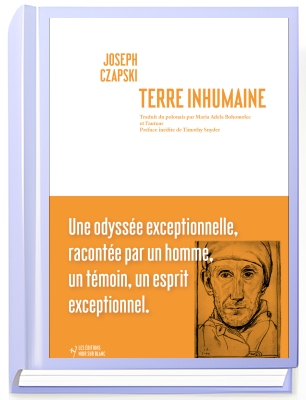
Bookshelf

Joseph Czapski: Terre inhumaine. Editions Noir sur Blanc, octobre 2020, 448 pages, 23 Euros /29 CHF

Traduit du polonais par Maria Adela Bohomolec. Collection La bibliothèque de Dimitri. Première parution : L’Âge d’Homme, 1978 Préface de Timothy Snyder Texte inédit : « Le récit de Witold »

En 1941, lorsque l’Allemagne envahit l’URSS, des dizaines de milliers de Polonais sont libérés des camps de prisonniers soviétiques et autorisés à rejoindre l’armée polonaise formée dans le sud du pays. Le peintre et officier de réserve Joseph Czapski est l’un des survivants de ce périple meurtrier. Parvenu à destination, il est chargé par le général Anders, commandant en chef de l’armée polonaise, d’accueillir les nouvelles recrues et d’enquêter sur la disparition de milliers d’officiers. Bloqué à tous les échelons par les autorités soviétiques, Czapski ignore en effet qu’en avril 1940, ils ont quasiment tous été abattus dans la forêt de Katyń. Le récit de Czapski sur les années qui ont suivi sa libération du camp, la formation de l’armée polonaise et son périple en Asie centrale, au Moyen-Orient et sur le front italien, représente un témoignage capital sur les souffrances des Polonais en URSS. L’auteur y mêle des portraits de ses compagnons, des réflexions philosophiques ainsi que le récit de ses rencontres avec de grandes figures littéraires, dont Anna Akhmatova.

Né à Prague en 1896 dans une famille austro-polonaise, Joseph Czapski est un artiste, peintre, écrivain et essayiste, et l’un des rares survivants du massacre de Katyń. Installé à Maisons-Laffitte, près de Paris, à partir de 1945, il participe à la fondation de la revue littéraire phare de l’émigration polonaise, Kultura. Il décède en 1993.
About the author

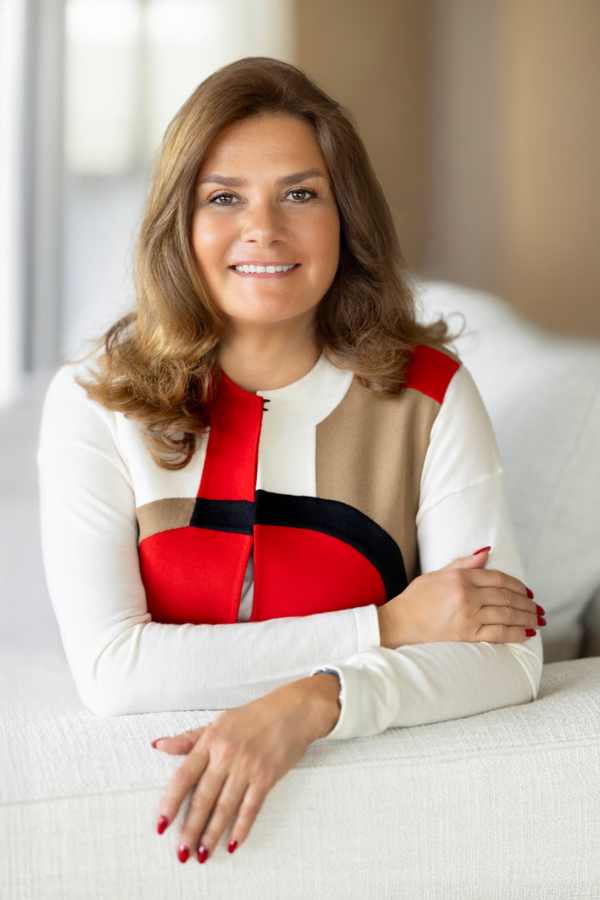
Nadia Sikorsky

Nadia Sikorsky was born and raised in Moscow. She graduated from the Faculty of Journalism at Moscow State University and went on to complete her postgraduate studies there, earning a PhD in History. She spent 13 years at UNESCO, first in Paris and then in Geneva. After serving as Director of Communications at Green Cross International, founded by Mikhail Gorbachev, she launched NashaGazeta.ch in 2007, Switzerland’s first Russian-language online daily newspaper.

In 2022, Nadia Sikorsky was named to Le Temps’ Forum des 100, which brings together individuals who, in the newspaper’s view, have “significantly contributed to the success of French-speaking Switzerland”, from across public life, business, politics, science and culture.

After 18 years at the helm of NashaGazeta.ch, Nadia Sikorsky decided to devote herself to what had always held a special place in her work as a journalist: culture in all its diversity. This led to the creation of Russian Accent, a trilingual cultural blog in Russian, French and English, born in the heart of Europe, in Switzerland, which has become her second home and whose multiculturalism and multilingualism have helped shape the character of this new project.

At the heart of the project is the perspective of a European of Russian origin, drawing on more than 35 years of professional experience and a deep knowledge of both cultural traditions. Nadia Sikorsky sees her role as that of a cultural mediator between the two. The title of the blog, Russian Accent, reflects this idea: the accent is neither a linguistic barrier nor a political position, but a distinctive cultural imprint within a European context.

Events
Most read

A new book by the Geneva-based Slavist Jean-Philippe Jaccard and his Russian colleague Andrei Ustinov, now living in San Francisco, has been published by the European University at St Petersburg: Vzir Zaumi. Daniil Harms and the Literary Avant-Garde of the 1920s. In the authors' own words, the volume offers a kind of X-ray of Leningrad's "left-wing " circles and their evolution during the period between Harms's poetic debut and the creation of OBERIU, as well as the dynamics that shaped those circles.

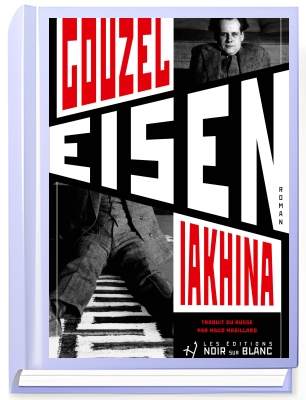
A few days ago, the Lausanne-based publisher Éditions Noir sur Blanc brought out Guzel Yakhina’s novel about the celebrated Soviet film director Sergei Eisenstein. French readers will be able to read it in Maud Mabillard’s translation and, importantly, in full, including the ninth chapter omitted from the Russian edition.