Svetlana Alexievitch est une auteure russophone majeure du XXe siècle, consacrée par le prix Nobel de littérature en 2015, dont l’œuvre explore les archives subjectives et la mémoire des anciennes républiques soviétiques. Elle a donné un grand nombre d’entretiens, à la presse russe en particulier, pour expliquer sa démarche et présenter la cohérence de son œuvre : peu d’entre eux sont traduits. Nous nous proposons dans ce volume de publier un de ses entretiens qui constitue une excellente présentation du travail de Svetlana Alexievitch. Intitulé « Le socialisme a disparu, mais nous sommes toujours là », il est paru en 2013 dans Droujba narodov (entretien avec Natalia Igrounova) et apporte des éléments importants sur la réception de son œuvre en Russie et ailleurs.
Le second texte inédit en français reproduit dans le volume est l’allocution que Svetlana Alexievitch a donnée à l’Université de Genève lors de la réception de son titre de Docteure Honoris Cause en octobre 2017. Dans celle-ci, à teneur plus autobiographique, elle expose l’importance de son milieu d’origine, la valeur déterminante qu’a jouée la Deuxième Guerre mondiale dans son éducation et sa formation et des éléments de sa méthode.
Cette publication est accompagnée de six textes critiques et d’une lettre de Daniel de Roulet, qui mettent tous en valeur la dimension littéraire de cette œuvre. Si l’on a souvent mis en avant le caractère puissant des témoignages qu’elle constitue, on a trop peu accordé d’attention à l’ancrage de Svetlana Alexievitch dans la tradition européenne de l’écriture de l’Histoire. Il s’agira donc de considérer la force littéraire de l’œuvre de Svetlana Alexievitch , qui nous oblige à nous confronter aux violences historiques et politiques de notre temp mais aussi à nous interroger sur ce que peut la littérature face aux conflits armés (La Guerre n’a pas un visage de femme, Les Cercueils de zinc), à la catastrophe nucléaire de Tchernobyl (La Supplication), à la chute de la société et du régime soviétiques (La Fin de l’homme rouge). L’orchestration des voix et le montage des documents révèlent la puissance pathétique de ses récits : l’Histoire est perçue depuis l’expérience individuelle en marge de l’héroïsme et bordée par l’effacement.
Nathalie Piégay
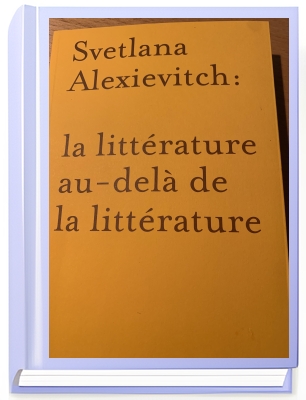
Svetlana Alexievitch : la littérature au-delà de la littérature
About the author

Nadia Sikorsky was born and raised in Moscow. She graduated from the Faculty of Journalism at Moscow State University and went on to complete her postgraduate studies there, earning a PhD in History. She spent 13 years at UNESCO, first in Paris and then in Geneva. After serving as Director of Communications at Green Cross International, founded by Mikhail Gorbachev, she launched NashaGazeta.ch in 2007, Switzerland’s first Russian-language online daily newspaper.
In 2022, Nadia Sikorsky was named to Le Temps’ Forum des 100, which brings together individuals who, in the newspaper’s view, have “significantly contributed to the success of French-speaking Switzerland”, from across public life, business, politics, science and culture.
After 18 years at the helm of NashaGazeta.ch, Nadia Sikorsky decided to devote herself to what had always held a special place in her work as a journalist: culture in all its diversity. This led to the creation of Russian Accent, a trilingual cultural blog in Russian, French and English, born in the heart of Europe, in Switzerland, which has become her second home and whose multiculturalism and multilingualism have helped shape the character of this new project.
At the heart of the project is the perspective of a European of Russian origin, drawing on more than 35 years of professional experience and a deep knowledge of both cultural traditions. Nadia Sikorsky sees her role as that of a cultural mediator between the two. The title of the blog, Russian Accent, reflects this idea: the accent is neither a linguistic barrier nor a political position, but a distinctive cultural imprint within a European context.