

In his lecture on Dead Souls by Gogol, one of the famous Lectures on Russian Literature prepared by Vladimir Nabokov for American students, we find the following passage: “In Russian, with the help of one ruthless word, it is possible to express the essence of a widely prevalent vice for which three other European languages known to me have no special designation. The absence of a particular term in the vocabulary of a nation does not necessarily mean the absence of the corresponding concept, but it hampers the completeness and precision of its understanding. The various shades of the phenomenon that Russians clearly express with the word poshlost are scattered among a number of English words and do not form a definite whole.”
Indeed, there is no exact equivalent for this “ruthless word” in English, French, or German. Nabokov, whose entire life and artistic path were marked by a struggle against poshlost, therefore tries to define the meaning of the concept as precisely as possible, writing that “poshlost is not only obvious trash but also literature that is falsely significant, falsely beautiful, falsely profound, and falsely engaging”.
This definition by a great writer applies not only to literature. It can and should be extended to other forms of art as well, for poshlost has infiltrated them too, to varying degrees. It has flooded television entertainment programmes; it stares us in the face from the canvases of certain painters, and it is increasingly encountered in dramatic productions and even in opera stagings whose creators apparently seek, with its help, to lower “high art” to the level of the mass consumption and make it “accessible”.
Perhaps the only genre that until now had remained untouched by poshlost was symphonic music: at least, I have never seen a conductor walk onto the stage in his underwear, a violinist make obscene gestures with his bow, or a trombonist produce indecent sounds not indicated in the score. But…
A few days ago, I received by email an invitation to a concert by the Orchestre des Nations, founded in 2011 by Antoine Marguier, a graduate of the Lyon Conservatoire in the clarinet class. On the orchestra’s website, where the ensemble if présented as a “symbol of intercultural sharing and peace”, bringing together “high-level non-professional musicians”, he is described as a “chef d’orchestre hors norme”, that is, a “conductor of exceptional stature”. I will refrain from commenting on this claim.
Having once attended a concert by the Orchestre des Nations, I would have immediately deleted the invitation had it not been for the title of the programme: “Vienna 1785 – Leningrad 1937”. This, as you can imagine, drew my attention, and I read the promotional announcement to the very end.
The text is short, so I will quote it in full – it is worth it. Note that in the original the maestro does not simply speak: he dixit, as if delivering an oracle. The heroine of Dmitri Shostakovich’s masterpiece is referred to precisely in this way – not Lady Macbeth, but Lady McBeth. If this was intended as a joke about Scottish roots, it falls flat: the name of the King of Scotland from 1040 to 1057 was written in Gaelic as Mac Bethad mac Findláich. And “accessibility” is also present – as the principal quality attributed to Mozart and Shostakovich. But judge for yourselves.

Vienna 1785 – Leningrad 1937
The final highlight of the anniversary season will be the last of the “Three Fifths” – Shostakovich’s Fifth.
“Three times five equals fifteen – the arithmetic checks out,” says the orchestra’s conductor. “We have never been in such excellent shape or so closely connected with our audience.”
Continuing with the mathematical theme, the programme brings together 250 years of music in a single concert: Mozart’s Piano Concerto No. 20 (soloist: Matei Varga) and Shostakovich’s Symphony No. 5.
A minor mode – a major scale
Written at the height of his career, Wolfgang’s concerto already reveals the emergence of Romanticism. “It already opens the door to something that deeply moves us. This is not merely the sparkling, sunlit, champagne-like Mozart we are used to, but a composer troubled within.”
“They say Mozart helps plants grow and calms newborn babies. It is magical, natural music, written seemingly with very little. That is where genius lies – and the same is true of Shostakovich.”
“Shosta”, as our poster puts it, also had every reason to be anxious. His Fifth Symphony marked a return to Stalin’s favour after eighteen months of disgrace: the “man of steel” had not appreciated his previous opera, Lady McBeth.
No manual required
Despite the contrast between heritage and modernity, the two composers share another trait: accessibility.
“It is fascinating that in 1937, after the Second Viennese School exploded tonality, Shosta arrives with something that is still tonal and reconnects us with our earlier reference points,” explains Antoine Marguier. “By that time you already need something like a user’s manual – but not here. This music has enormous emotional power.”
A programme that will please both the audience and the musicians themselves. “When musicians play with enthusiasm, the message reaches the listener – you can feel it. Emotion guaranteed: that is our trademark.”
I do not know who wrote this announcement – whether Mr Marguier himself or one of his “communications specialists”. Emotions were indeed guaranteed. Or rather, not emotions but a physiological reaction – you know that feeling when nausea rises in your throat. Quite apart from the generally breezy tone worthy of a street hawker, the main triggers for me were, of course, the familiar “Wolfgang” and “Shosta”.
Let Mozart’s fellow countrymen defend the Salzburg genius if they feel the need. As for me, I will say a few words about a genius closer to my own heart – the one from Leningrad. In fact, not so much about him as about his Symphony No. 5, written very quickly in 1937, such a terrible year in the history of my country.
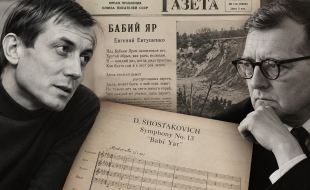
The sword of Stalinist injustice fell upon Dmitri Dmitrievich Shostakovich in early 1936, after the publication on 28 January in the newspaper Pravda of the infamous – and unsigned! – article “Muddle Instead of Music”, which denounced the opera Lady Macbeth of the Mtsensk District for its “formalistic” and “anti-popular” character. Most remained silent then, but not everyone. In his book The Bolshoi, Solomon Volkov quotes Andrei Platonov, Isaac Babel, Nikolai Myaskovsky, Yuri Shaporin and Yuri Olesha: “The authors of this article discredit themselves. Great art will survive regardless.”
Art did survive, but the persecution of Shostakovich began after that article. The premiere of his Fourth Symphony, which he nevertheless found the strength to complete in the following months after the Pravda publication, was scheduled for 11 December 1936 in Leningrad but postponed for twenty-five years, until 1961, in Moscow. The composer expected to be arrested at any moment, and film music became the main source of livelihood for him and his family.

The Fifth Symphony was first performed on 21 November 1937 in Leningrad by the Leningrad Philharmonic Orchestra under Yevgeny Mravinsky and became a sensation. The audience clearly understood that the symphony was Shostakovich’s response to the accusations levelled against him and tried to read “between the notes”. And the notes conveyed the extreme tension of the composer’s inner forces, the search for a way out by a persecuted man, his suffering, his turmoil and his sense of doom expressed in the sombre march, yet at the same time the final triumph of Life.
The composer himself wrote in the article “My Creative Reply” (“a Soviet artist’s creative reply to just criticism”), published in Vecherny Leningrad on 6 November 1937, two weeks before the premiere and passed through the sieve of censorship: “The theme of my symphony is the formation of the personality. It is man with all his experiences whom I saw at the centre of the conception of this work, lyrical in its nature from beginning to end. The finale resolves the tragic tensions of the earlier movements in a joyful and optimistic spirit…”
In the poem “Music”, dedicated to D. D. Shostakovich, Anna Akhmatova wrote:
She alone speaks to me
When others are afraid to come near,
When the last friend has turned away.
So to smirk at all this and allow oneself to call a great composer “Shosta” can only be the work of a… perfect speciment of poshlost. I think there is no longer any need to translate that word.
P.S. Treat yourself to a recording of Dmitri D. Shostakovich’s Fifth Symphony, made in 2018 by Maestro Yuri Temirkanov in the Grand Hall of the St Petersburg Philharmonia, which bears Shostakovich’s name — a name that deserves to be written in full.







Philippe Lüscher March 26, 2026
Sikorsky March 26, 2026
Philippe Lüscher March 26, 2026
Laurent Lévi-Strauss March 26, 2026
Sikorsky March 26, 2026