
Le Piano symphonique is probably the youngest of Switzerland’s many music festivals. It was born in 2022, a difficult year for European culture, at a time when so many things seemed to be disappearing forever, including the Zaubersee Festival, which had taken place in Lucerne over the previous ten years and was considered “Russian”, both because of the origin of its sponsors and because of the strong “Russian accent” of its programmes. But the enterprising director of the Luzerner Sinfonieorchester (LSO), Numa Bischof-Ulmann, managed to turn the situation around and transform Lucerne into a “magical place of pilgrimage for piano lovers”, as the festival’s website puts it. Thus, the Orchestra and its artistic director Michael Sanderling have become the “base” of the new festival, which takes place at the KKL Luzern concert hall designed by Jean Nouvel, undoubtedly the finest concert venue in Switzerland. It is there that the Orchestra invites distinguished soloists. In this respect, the festival reminds me of its Saint Petersburg counterpart, the “Arts Square” Festival, conceived by maestro Yuri Temirkanov, which in its best years brought together stars from all over the world.
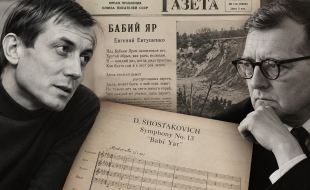
I attended Le Piano symphonique for the first time last year, drawn by its special “Shostakovich Project”, conceived by the pianist Evgeny Kissin, who has been designated a “foreign agent” by the Russian authorities, and dedicated to the fiftieth anniversary of the death of Dmitri Shostakovich. I was prepared for the emotional intensity of the concerts of “Kissin & Friends”, but I did not expect the overwhelming impression created caused by the performance of the trio made up of Martha Argerich, Mischa Maisky and Janine Jansen. It was Mischa Maisky’s first appearance after a serious illness. Martha Argerich, too, was recovering from the flu, but the long-time friends did not cancel the concert. They came on stage hand in hand, discussed on stage what they would play as an encore, their sheet music fell to the floor, Martha Argerich picked it up, while Mischa Maisky sat with his face buried in his hands. They played divinely; there is no other word for it. As if it were the last time.

Fortunately, it was not! This year, the wonderful ensemble will appear once again on the KKL stage. On 16 January, the musicians will perform Beethoven’s Piano Trio No. 5 in D major, Op. 70, known as the “Ghost Trio” (Geistertrio). Interestingly, this title was not given by the composer himself but by someone else, as has occasionally happened with Beethoven’s works. It is up to the listeners to judge how fitting it is. Here are, however, a few elements for reflection. The trio was composed in 1808, a year of trials for Beethoven: his hearing was deteriorating, and he lacked stable sources of income. It was at this time that he became close to Countess Anna Maria (Marie) von Erdődy. According to biographers, Beethoven offered moral support to the incurably ill woman, who, despite her illness, lived until 1837, while she presumably supported him financially. The exact role Marie Erdődy played in the composer’s life remains largely a mystery. Some scholars regard her as a possible candidate for the role of the “Immortal Beloved”; others consider this unlikely, since the countess was married. Be that as it may, after spending some time in her hospitable home, Beethoven dedicated to her two piano trios grouped under Op. 70. Perhaps it is the countess’s ghost that hovers over one of them? As for the music, the “ghostly”, mysterious quality is present only in the second movement, Largo assai ed espressivo. Listen to the soft tremolo in the piano part and to the melancholy melody that emerges from it… and glance around, in case someone dressed in white should pass by.
Earlier that same Friday, 16 January, I will go to the Schweizerhof Hotel, where Leo Tolstoy stayed in the summer of 1857 and wrote his short story Lucerne. I will go there to hear, for the first time, the Russian pianist Roman Borisov, aged twenty-three. Born in Novosibirsk, he began taking his first music lessons at the age of three at his parents’ initiative, on an electronic piano. He then received his musical education at the College attached to the Novosibirsk Conservatory, in the class of the pedagogue Mary Lebenson, who herself had studied first at the legendary Odessa music school of P. S. Stolyarsky, in the class of Berta Reingbald, the principal mentor of Emil Gilels, and later at the Moscow Conservatory in the class of Alexander Goldenweiser. Roman Borisov studied with Mary Lebenson for thirteen years and still considers entering her class to have been the most important event of his life. “She taught me everything, absolutely everything that I am,” he said in one interview. Professor Lebenson passed away in 2020, and Roman continued his studies at the Hanns Eisler School of Music in Berlin under Professor Eldar Nebolsin, born in Tashkent and a pupil of the famous Russian pianist Dmitri Bashkirov. A fine lineage of musical tradition.

Despite his young age, Roman Borisov has already won, as the youngest laureate, the Young Pianists’ Competition in Bad Kissingen, Germany, in 2022. He is also the laureate of more than a dozen Russian and international competitions, including the First Vladimir Krainev International Piano Competition in Moscow. He has taken part in the 15th ArsLonga International Festival, the 22nd Piano en Valois Festival in France, the 5th Trans-Siberian Art Festival in Novosibirsk, and in musical projects of the Vladimir Spivakov Foundation, and has performed in Germany and Switzerland. I mentioned him in 2021 when presenting the programme of the International Menuhin Festival in Gstaad, though I did not have the opportunity to hear him then. The programme of his upcoming concert in Lucerne will include Clara Schumann’s Mazurka No. 5, Op. 6, as well as Robert Schumann’s Davidsbündlertänze, for which this mazurka served as a thematic starting point. It will be equally fascinating to hear Chopin’s Mazurka No. 4, Op. 17, and one of the transcriptions of Chopin’s Études, also written in the rhythm of this Polish folk dance, by the Polish composer Leopold Godowsky (1870–1938), a work that demand the highest virtuosity from the pianist. I am very pleased that Swiss music lovers will also hear the Three Pieces for Piano (Prelude, Waltz and Mazurka) by the Russian composer Anatoly Lyadov (1855–1914), which are not often performed in Europe.
I will arrive in Lucerne the day before, in order to hear, for the second time this month, Sergei Prokofiev’s Third Piano Concerto, performed by the French pianist Alexandre Kantorow. I spoke about him very recently, so I will not repeat myself here. I very much regret not to be able to attend, on 14 January, Mozart’s Piano Concerto No. 20 performed by Alexandra Dovgan, a graduate of the Central Music School attached to the Moscow Conservatory, who is not yet twenty, nor to be present at the debut of the British conductor Robin Ticciati at the podium of the Lucerne Symphony Orchestra. I hope you will be luckier than I! You can consult the full programme of this year’s edition of Le Piano symphonique and purchase the remaining tickets here; I made sure to secure mine well in advance. So, shall we meet in Lucerne?
P.S. I end this first publication of the new year with an invitation to join me on social media: “Russian Accent” pages are now available on Facebook and Instagram.