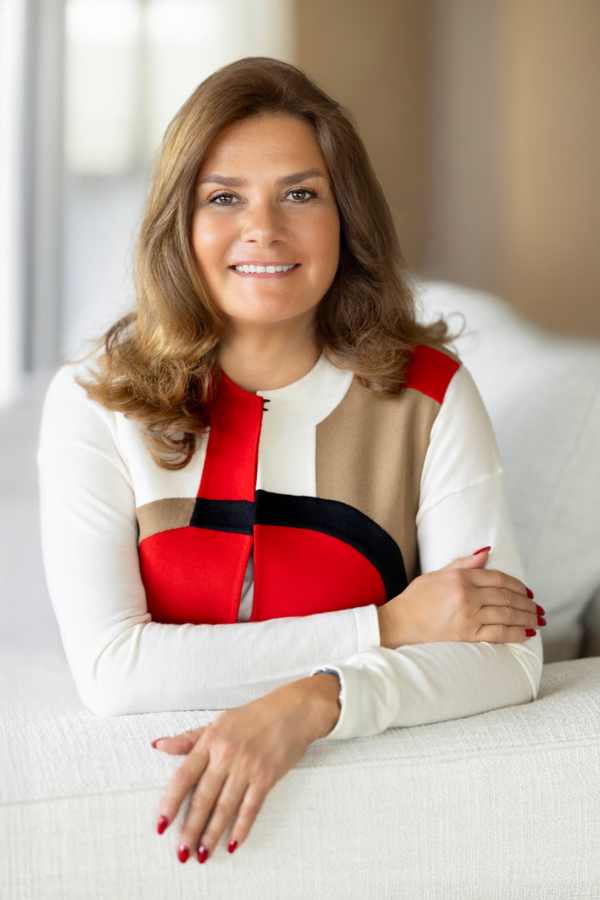

Yes, long-time friends Anastasia Volchok and Alexei Volodin performed together for the first time at Zurich’s Tonhalle in December 2024. “Alexei and I have known each other since school, but somehow we had never played together, so the upcoming concert will be our joint debut,” Anastasia, who initiated the idea, told me at the time. “I think we complement each other musically, and we wanted to give it a try.”
Anastasia Volchok was not mistaken: that concert went splendidly, and now, as Anastasia and Alexei prepare to perform in Geneva, one can probably speak of an established duo. For those who, for some reason, are not yet familiar with them, a few words about its members.
Anastasia Volchok was born in Moscow into a musical family. Her parents, Mikhail Volchok and Larisa Dedova, are pianists who have for many years taught at the School of Music of the University of Maryland in the United States. As for Anastasia, she received her professional training at the Moscow Conservatory and the Basel Academy of Music and won First Prize and the Gold Medal at the 2003 Cincinnati International Piano Competition; she has lived in Switzerland for more than twenty years.
Alexei Volodin was born in 1977 in what was then still Leningrad. By Soviet standards he began studying music late, at the age of nine. He graduated from the Moscow State Conservatory and completed postgraduate studies under Eliso Virsaladze, later becoming her assistant. In 2001 he continued his education at the International Piano Academy Lake Como in Italy. The year 2003 was also decisive for Alexei: it was then that this exclusive Steinway & Sons artist won the Géza Anda International Piano Competition in Zurich, after which both his international career and his special relationship with Switzerland began to develop rapidly.
What will they play for us, given that the repertoire for two pianos is limited? Rachmaninov’s Suite No. 2, Op. 17, is listed last in the programme, yet it was with this work that everything began. “It seemed very important to us to play Rachmaninov,” Anastasia Volchok comments on their choice. “And not only because he is my favourite composer. His music resonates particularly strongly now: on the one hand there is longing for one’s homeland, and on the other optimism and new perspectives.”
To hear these moods more clearly in Rakhmaninov’s music, it is useful to bear in mind that the Second Suite was written in 1901, at the dawn of a new century, when even so perceptive a figure as Rachmaninov could hardly have imagined how many misfortunes that century would bring. Or could he? How else can one explain the solemn monumentality, even imperial grandeur if you will, of the first movement, in which even a non-musician may catch echoes of the famous chorus from Glinka’s opera A Life for the Tsar, followed by a march, suggestive of war, and the headlong momentum of the second movement, a veritable whirlwind of events? Suite No. 2 concludes with an Italian Tarantella, developed, as experts maintain, in a Russian manner, that is to say not in a light dance spirit but with symphonic depth, emotional expansiveness and dense thematic development characteristic of the Russian compositional school of the late nineteenth century. Was the Suite a harbinger of the composer’s forthcoming enforced wanderings, with a lengthy stay in Switzerland at Villa Senar near Lucerne?
Many of us lack optimism today, as well as new perspectives. There can therefore be little doubt that listeners will appreciate the “life-affirming major key of Mozart’s Sonata”, to use Anastasia Volchok’s expression. This twenty-five-minute Sonata, numbered K. 448, is one of Mozart’s few works for two pianos. It was written in 1781, when the composer was twenty-five years old. As any reference book readily confirms, the Sonata is cast in strict sonata-allegro form, in three movements, in the galant style, with intertwining melodies and simultaneous cadences. It was written for a specific occasion, namely a joint performance with the pianist Josepha von Auernhammer. It is therefore only natural that at the forthcoming concert the Sonata will also be performed by musicians of different genders, as the phrase now goes.
Two further works included in the programme are examples of what is currently very much in vogue: dialogues. Clearly neither Camille Saint-Saëns, when composing his Variations on a Theme of Beethoven in 1874, his largest piano work, nor Poland’s leading classic after Chopin, Witold Lutosławski, when writing his Variations on a Theme of Paganini, or, more precisely, on the opening theme of Paganini’s Twenty-Fourth Caprice, were concerned with what was in vogue. Saint-Saëns, who wrote comparatively little for the piano, perhaps wished to affirm his reputation as the “French Beethoven”, though musicologists generally agree that he did not quite succeed. Lutosławski, for his part, created one of his most popular works out of necessity: during the German occupation of Poland, he was compelled to earn his living playing the piano in Warsaw cafés, sometimes in a duo with another composer, Andrzej Panufnik. Out of this almost forced form of music-making a short piece was born, lasting barely five minutes, yet utterly brilliant. “When one composer takes another’s theme and develops it in his own way, it is always fascinating, because something new inevitably appears. I hope something new will also emerge in Alexei’s and my duo, and that audiences will be interested to hear us,” Anastasia told me a little over a year ago.
Something new has indeed emerged (note the musicians’ identical initials – AV), and it is now for you to judge it by attending the duo’s concert at Geneva’s Victoria Hall on 23 March. Do not forget to purchase your tickets!