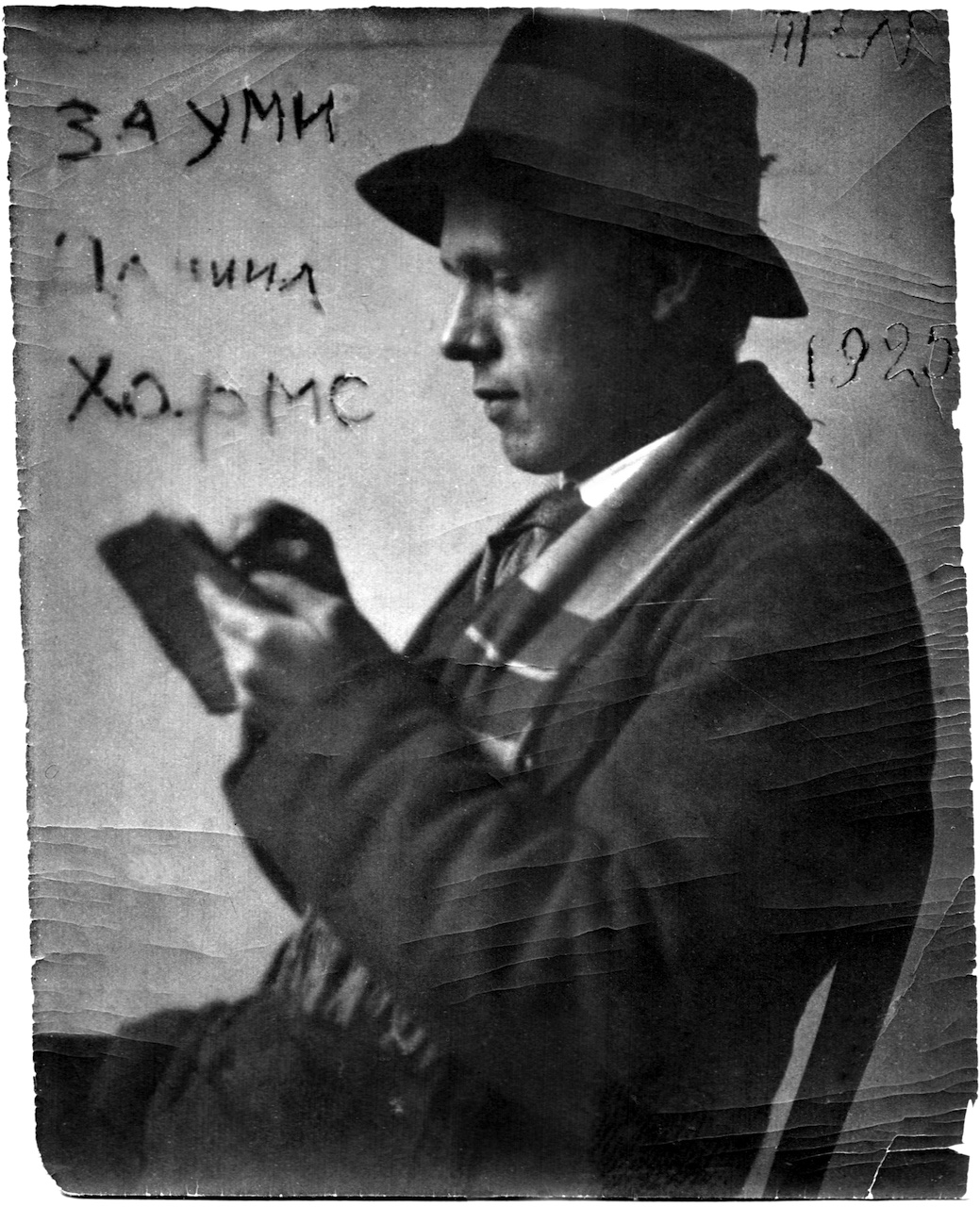
Daniil Harms (Daniil Ivanovich Yuvachev, 1905-1942) lived for only thirty-seven years, yet became one of the most enigmatic figures in twentieth-century Russian literature. A poet, prose writer, playwright and member of the avant-garde group OBERIU (the Association for Real Art), he created absurd, comic and unsettling texts that were decades ahead of their time. During his lifetime he published very little, earning his living mainly through children's literature, while his "adult" work circulated only in manuscript form and among friends. In 1931 he was arrested and exiled from Leningrad, and in August 1941 he was arrested again, this time following a denunciation for "anti-Soviet sentiments". Fearing execution, Harms feigned mental illness and was confined to the psychiatric ward of the Kresty prison hospital, where he died during the Siege of Leningrad on 2 February 1942, most likely of starvation, although the exact circumstances of his death remain unknown. Although rehabilitated in 1960, he was rediscovered by readers only decades after his death and is now regarded as one of Russia's major avant-garde writers, whose absurd miniatures proved to be an astonishingly accurate reflection of a tragic era.
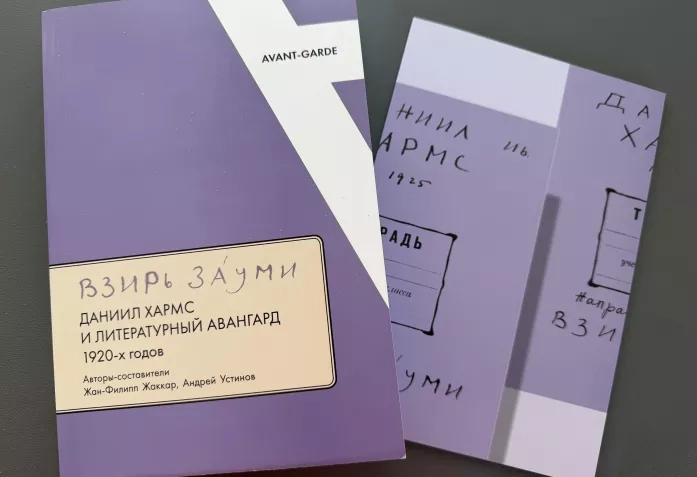
Jean-Philippe, the first time I interviewed you was in 2008. I addressed you formally then and called you Professor. It is rather amusing to reread that interview today. Back then I was telling readers about the Russian translation of your book Daniil Harms and the End of the Russian Avant-Garde (St Petersburg, Akademichesky Proekt, 1995). Today we are speaking because of the publication of Vzir Zaumi. Daniil Harms and the Literary Avant-Garde of the 1920s, which you wrote together with the Russian scholar Andrei Ustinov, thirty years after that first publication and on the occasion of the 120th anniversary of Daniil Harms's birth. The book has been published in St Petersburg by the European University Press, which appears to have continued its work in Russia despite the war against Ukraine. In our conversation in June 2022, you said that you believed in «normal» people. Should your collaboration with Russian colleagues be seen as an expression of that belief? And how has the war affected your project?
The war had no impact on our project because it had been conceived and launched before the war began. It simply stretched on for a very long time until the book finally materialised, just in time for the Harms anniversary.
Originally, and rather egocentrically, the project was conceived to mark the thirtieth anniversary of the first publication that Ustinov and I produced together in 1991. That publication was one of the first examples of collaboration between a Soviet scholar and a Western colleague. At the time, we published previously unknown texts by Harms in the Wiener Slawistischer Almanach, and in 2021 we decided to celebrate that earlier achievement by republishing the volume together with everything that had been accomplished in the intervening years.
Then came Covid, followed by the war. The publication of the book was repeatedly postponed, but it eventually appeared. And yes, we produced it together with the "normal people" at the European University, which demonstrates our desire to continue working with "normal people" in the future, both there and here. There are far too many “abnormal” people around us, both there and here. The fact that the European University at St Petersburg is still functioning surprises even its own staff. There were attempts to shut it down under the pretext of fire safety regulations. It lost its original premises but moved elsewhere and continues to operate.
In the introduction, you and Andrei Ustinov write that Harms's papers held at the Pushkin House archives were, and remain, inaccessible even to researchers. Why?
Because the archivists guard them jealously. It is a legacy of the Soviet era. At the time, we obtained the texts we needed through… smuggling. A helpful man, who has since passed away, simply photographed them for us.
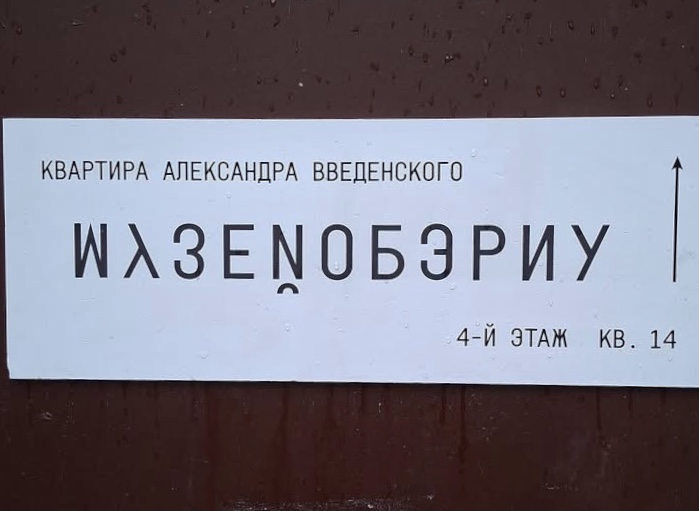
One could say that Harms's anniversary is being marked not only by your book but also by the OBERIU Museum, which opened in St Petersburg at the end of last year in the former apartment of the poet Alexander Vvedensky, who was also arrested in 1941 on charges of counter-revolutionary agitation and died shortly afterwards. To some, the opening of this museum may look like an act of hypocrisy: first persecute poets, then immortalise them. Do you see it that way?
No. I think it's just the usual chaos of Russian cultural life. I remember that several years ago, before the war, a schoolteacher was dismissed because she taught "forbidden" poets, that is, poets who had once been repressed: Vvedensky, Harms and others. This happened despite the fact that both Vvedensky and Harms were being published in huge print runs, and a theatre not far from the school was staging Harms's play Yelizaveta Bam.
Besides, the OBERIU Museum is a private rather than a state initiative. Last year a Moscow businessman named Andrei Gnatyuk bought the former communal apartment where Vvedensky had lived and decided to turn it into a museum. And he did.
I know you attended the opening. Was it worth the trip?
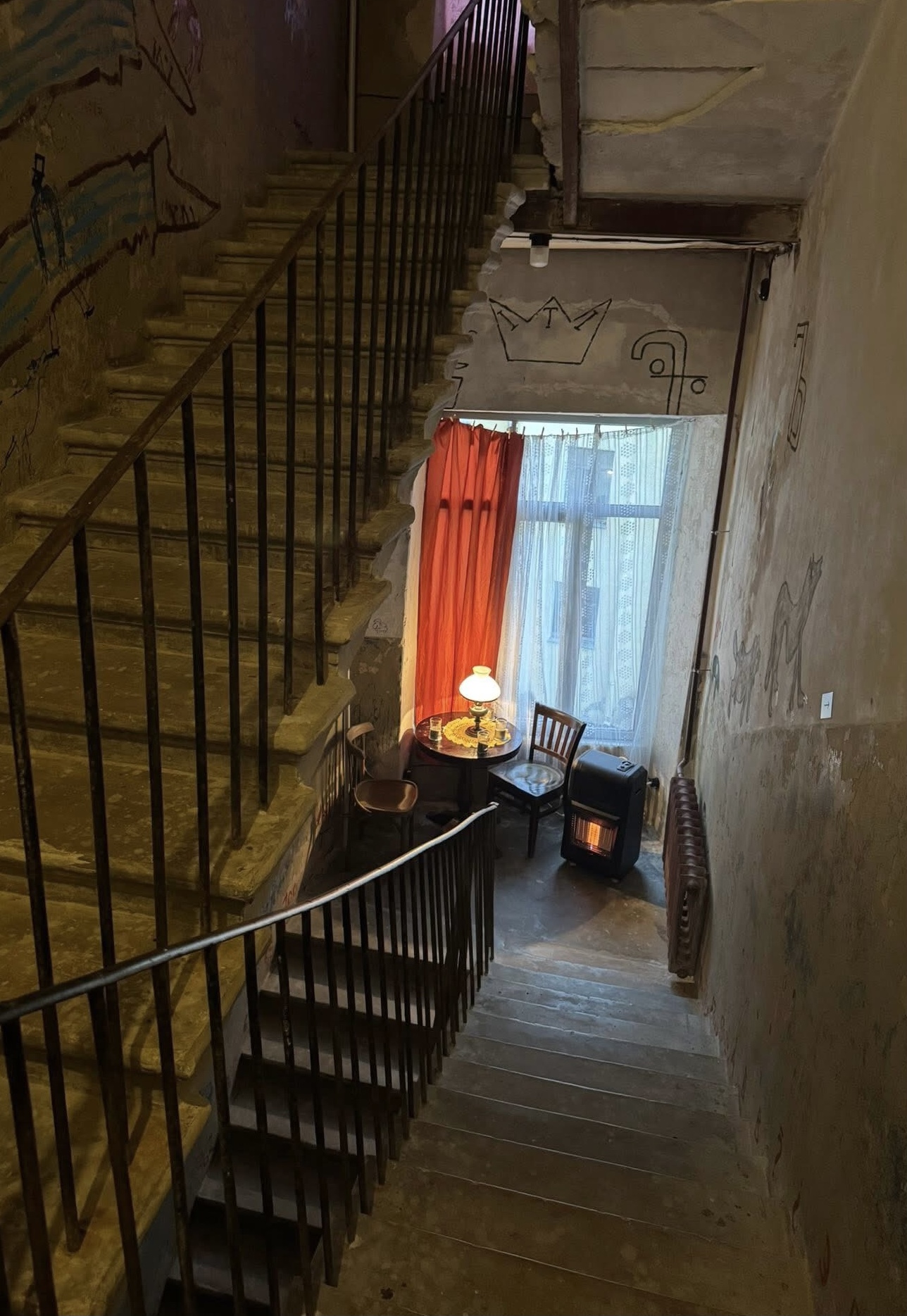
Absolutely. What was extraordinary was seeing with my own eyes that strange trapezoidal room of Vvedensky's, once described as a coffin by Harms's close friend Yakov Druskin, the Soviet philosopher and musicologist who saved the archives of both Harms and Vvedensky during the Siege of Leningrad. To see it with my own eyes was extraordinary.
As in every Soviet apartment, especially a communal one, the kitchen occupies a central place in the museum. There is an extraordinary amount to see there: books, documents, artefacts and a library that even includes my own 1995 book. One can even see Alexander Vvedensky's final letter to his mother, written shortly before his death.
The museum's opening was only provisional. The work continues and can almost be compared to an archaeological excavation. A handprint was discovered high up on one of the walls. Judging by the height, it may well be Harms's handprint, since he was the only one in that circle who was that tall.
All of this is being carried out by energetic young enthusiasts. One of the driving forces behind the project, Yulia Senina, is not yet thirty. That gives one hope.
Why won't Harms let you go?
Harms has let me go. I have a mildly ironic attitude towards people who devote their entire lives to a single author. But first, Harms is anything but boring, so one can always return to him from time to time. And second, it is not Harms who keeps drawing me back, but people. He remains an immensely popular writer, and I am constantly invited to conferences connected with him. I do not accept all those invitations, however, because I have no new information to offer.
Who is the new book intended for?
Oddly enough, for a very wide readership, largely because Harms is such a popular writer. Almost the entire print run sold out within the first five months, despite the fact that this is an expensive academic volume, richly illustrated, with facsimiles and a substantial scholarly apparatus. But nobody is obliged to read all the notes! Many readers are interested primarily in the poems and original texts themselves, of which the book contains a great number, including several published for the first time. And the archival documents from those years often read like detective stories. The mid-1920s were a pivotal moment in the history of Russian culture, while the repressions that were already beginning foreshadowed what was to come.
I think many Russians today no longer know what zaum means, despite the fact that the word appears on your book's cover. How would you explain this distinctly Russian literary phenomenon, one that seems virtually impossible to translate into other languages?
In fact, it is quite easy to explain. The term was coined in the 1910s to describe phonetic poetry. Literally, it means "beyond reason". It is a form of thought that bypasses the mind and speaks directly to the emotions. The creation of a new, purely poetic and phonetic language is the literary equivalent of Suprematism or abstraction in painting. In other words, Malevich's Black Square and the zaum of the Futurist poet Aleksei Kruchenykh are equivalents.
In short, zaum is abstract poetry, even if the concept later expanded considerably. Harms's "transrational" verse contains relatively few purely phonetic passages, but sound and rhythm take precedence over rational meaning.
Literature in the Russian Empire, later in the Soviet Union, and now once again in Russia, has always played a particular political role. As you point out in your book, by the late 1920s the word zaum, which originally meant nothing more than strange poetry, had already become a synonym for "counter-revolution". Why? And why is anything different, strange or difficult to understand so often perceived as a threat?
True art is always slightly ahead of its time. We speak of the avant-garde using a military term, which is precisely why Ionesco disliked the term: it inevitably implies the existence of a rearguard, and that already suggests tradition. Genuine art is always avant-garde. It has to be ahead of something and is therefore bound to attract criticism.
The same thing happens in society. People disapproved of the first person to walk down the street in shorts. Today everybody wears them. In both art and life, this tends to be seen as "revolutionary behaviour". In reality, it is nothing of the sort.
The situation in Soviet Russia in the late 1920s was somewhat different, however, because everything was gradually narrowing towards a single acceptable canon: the emerging canon of Socialist Realism. It was a time of struggle on all fronts. Culture, along with all those eccentrics and originals who inhabited it, was naturally perceived as a threat. In the West, things never went as far as the physical elimination of people, but similar processes were at work: people debated, criticised and condemned.
A full century now separates us from the events described in your book. Can one speak of Russia moving backwards, of a new version of an old canon being imposed?
I do not think so. The regime is different. Censorship has undoubtedly become more pervasive. I remember the case of an edition of Pasolini's memoirs in which entire passages had simply been blacked out. At first it seemed almost funny. Later, it ceased to amuse.
But these are acts of censorship, not an organic literary or artistic process aimed at establishing a new aesthetic canon. At least for now. In the 1930s, even the underground was physically destroyed. So there is still a difference, and today's situation is more reminiscent of the final years of the Soviet regime. Again, for now. I very much hope things do not become worse.
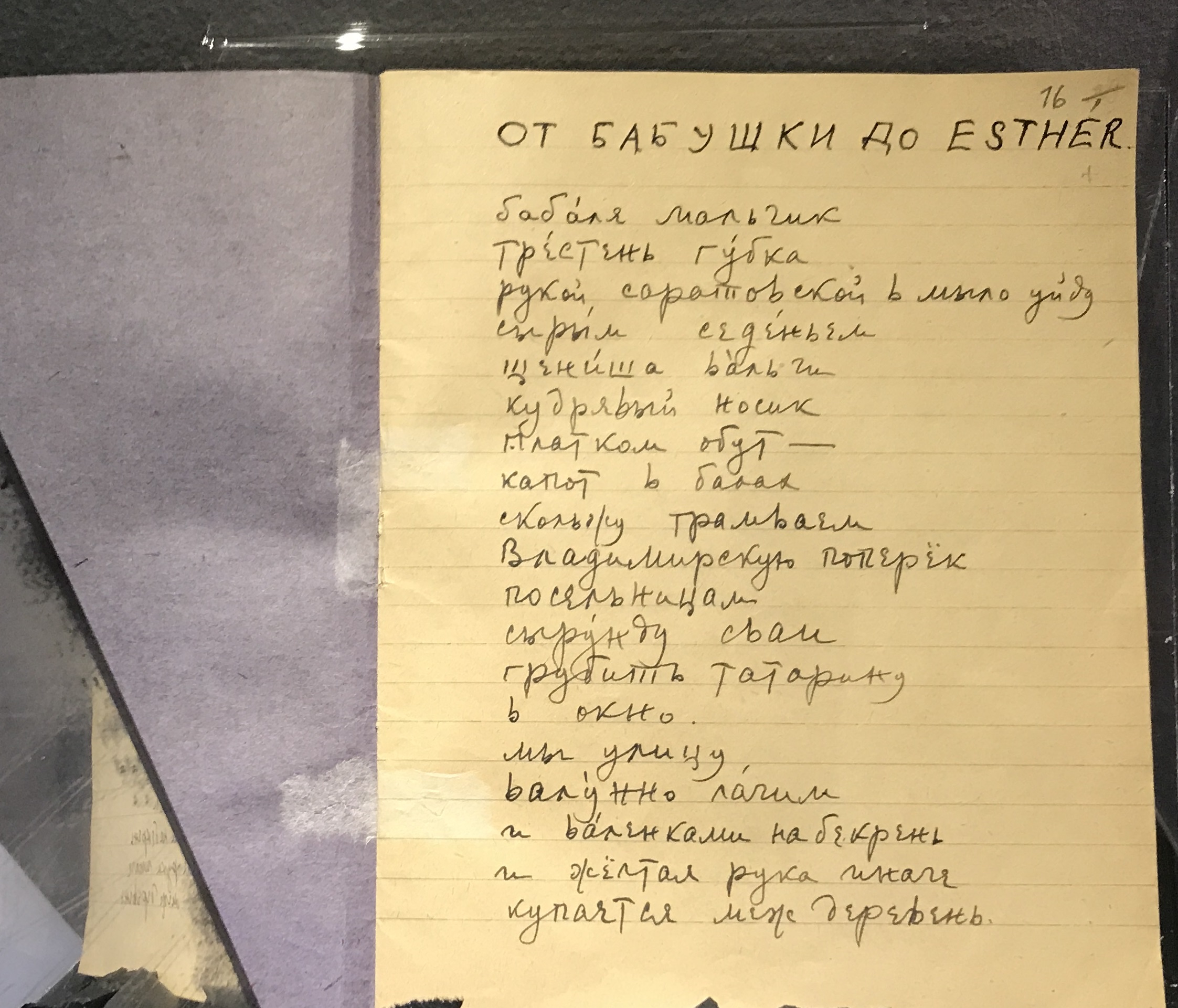
In the book you quote the German phrase "Gott mach dass ich hier lernen weiter werde", which literally means: "God, let me do on studying here." On 9 June 1925, Daniil Yuvachev, the future Harms, addressed this plea to God, fearing that he might be expelled from the Leningrad Electrotechnical College. As we know, the prayer went unanswered. But what interests me is something else. Why do you and Andrei Ustinov draw attention to this phrase twice? What does it tell us about Daniil Harms?
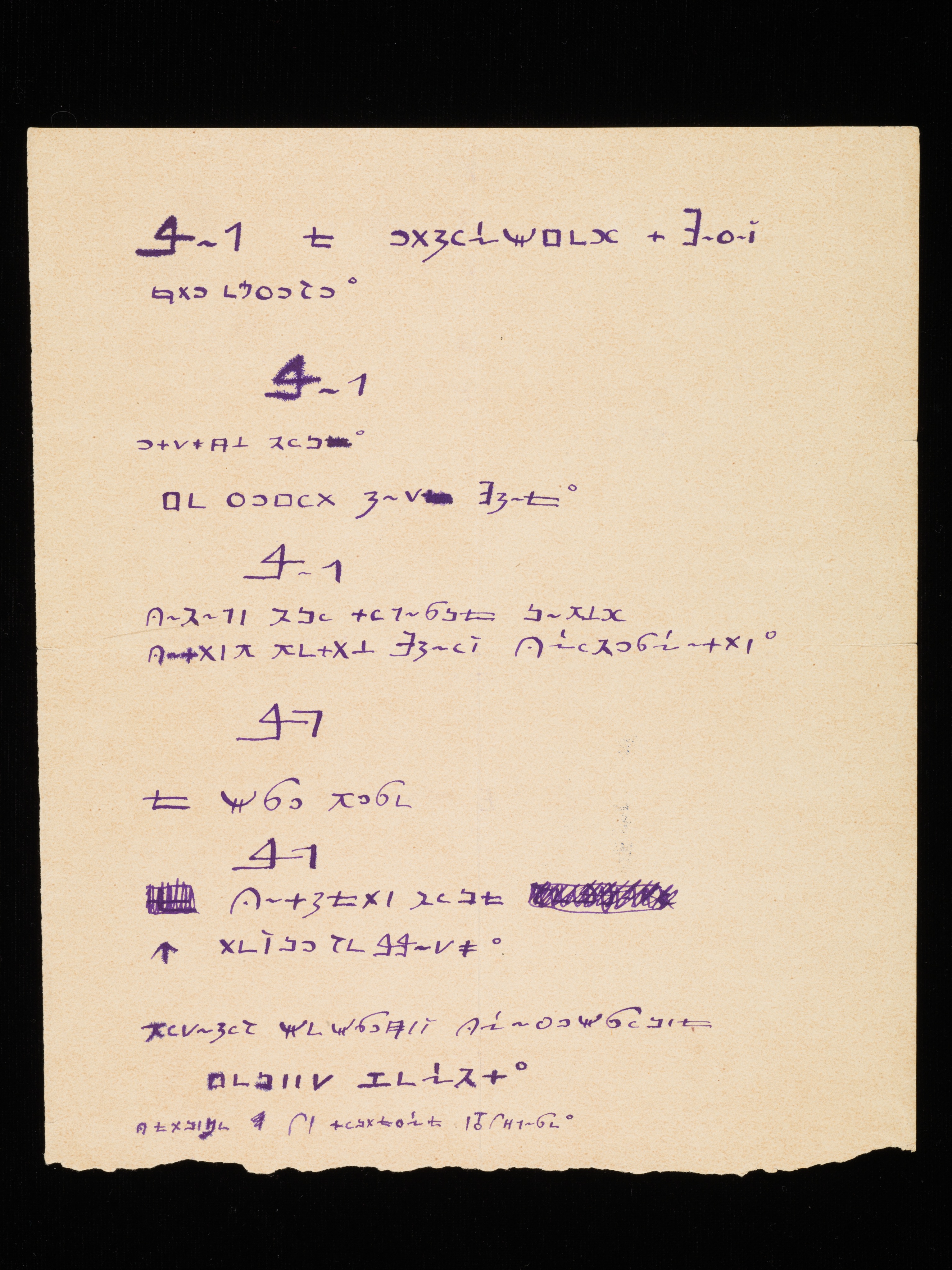
The phrase belongs to the year with which our book begins, a crucial year in Harms's life. It was in 1925 that he began to write. He was studying and he was bored. His command of German is often exaggerated. His diary entries in German contain plenty of mistakes. What interests us in this phrase is his appeal to God. Harms would continue addressing God throughout his life, in both German and Russian. He even created a special alphabet, a kind of cipher for such appeals to God, but also for recording various intimate aspects of his life. Incidentally, one page from one of his manuscripts is preserved at the Bodmer Foundation in Geneva.
The year 1925 marked a turning point in his life. He abandoned his studies, left technical college, began gathering the left-wing avant-garde around him, started writing poetry, turned to Malevich, and so on.
It should be said that Harms's other writings, from private correspondence to applications submitted to various institutions, also contain grammatical and spelling mistakes. Yet his poetry, with its references to the Bible, Sophocles and many other sources, reveals a highly educated man. How do you explain this? And how does it fit with the admission requirements of the Leningrad Union of Poets, where formal literacy ranked above all else?
I do not always know how to interpret some of Harms's apparent mistakes: are they jokes or genuine mistakes?
I remember that when his first book appeared in 1985, everything had been cleaned up and corrected in accordance with the norm, which covered the poetry. That, of course, destroyed much of what makes Harms unique. It would be like publishing Apollinaire and inserting commas everywhere. It is clear that Harms had problems with spelling, but it is equally clear that he deliberately played with it.
The newspaper articles reproduced in your book vividly reflect both the atmosphere of the country at the time and a number of phenomena that outlived not only the Union of Poets and OBERIU, but even the Soviet Union itself. One of them is the seemingly eternal rivalry between St Petersburg/Leningrad and Moscow. Here is a delightful passage from Krasnaya Gazeta from November 1926: "There can be no doubt that the average standard of poetic work in Leningrad is far higher than in Moscow, that our poets take their work much more seriously and approach it with greater care than Muscovites. This is true even of the 'major' poets: none of Leningrad's literary names produces the sort of hackwork with which Moscow's 'luminaries' so often supply Leningrad's editorial offices. To judge the overall level of poetic culture in our two capitals, it is enough to compare the poetry collections published this year by the Moscow and Leningrad Unions of Poets." How would you comment on that?
Oh, I am patiently waiting for someone to write a history of the rivalry between the two capitals. It would make a fascinating book. All the historical differences were already clearly visible during the avant-garde period: in Moscow there was the rebellious Mayakovsky, while in Petrograd there was Mikhail Matiushin and an entirely different visual culture.
The rivalry continued throughout the Soviet period. The Leningrad and Moscow underground scenes of the 1960s to 1980s were completely different phenomena, although there were points of contact. In Leningrad the emphasis was on religion, the Silver Age and the restoration of cultural continuity, whereas Moscow was more oriented towards postmodernism and other fashionable Western trends.
Leningraders in the 1920s felt they had to defend themselves to some extent, because all the trouble came from Moscow. Take Malevich's work at the Leningrad branch of GINKhUK (the Institute of Artistic Culture), which ran counter to the official line of Moscow's INKhUK under the People's Commissariat, effectively the Ministry of Education, even under Lunacharsky. Malevich turned it into a free space where all the left-wing, avant-garde forces gathered.
Naturally, the institute was shut down. By 1926, such things were no longer tolerated. That was precisely when Harms began to write.
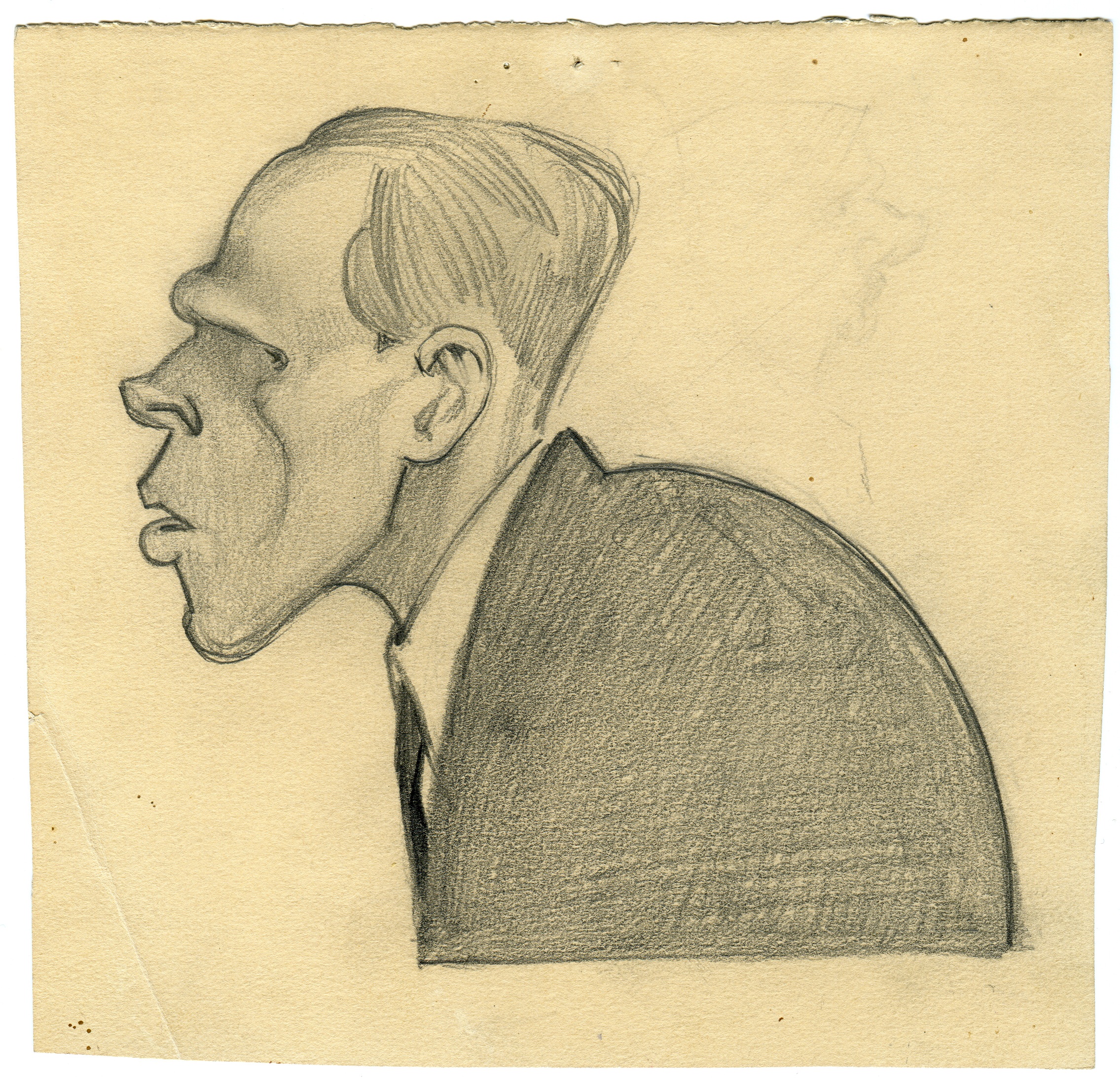
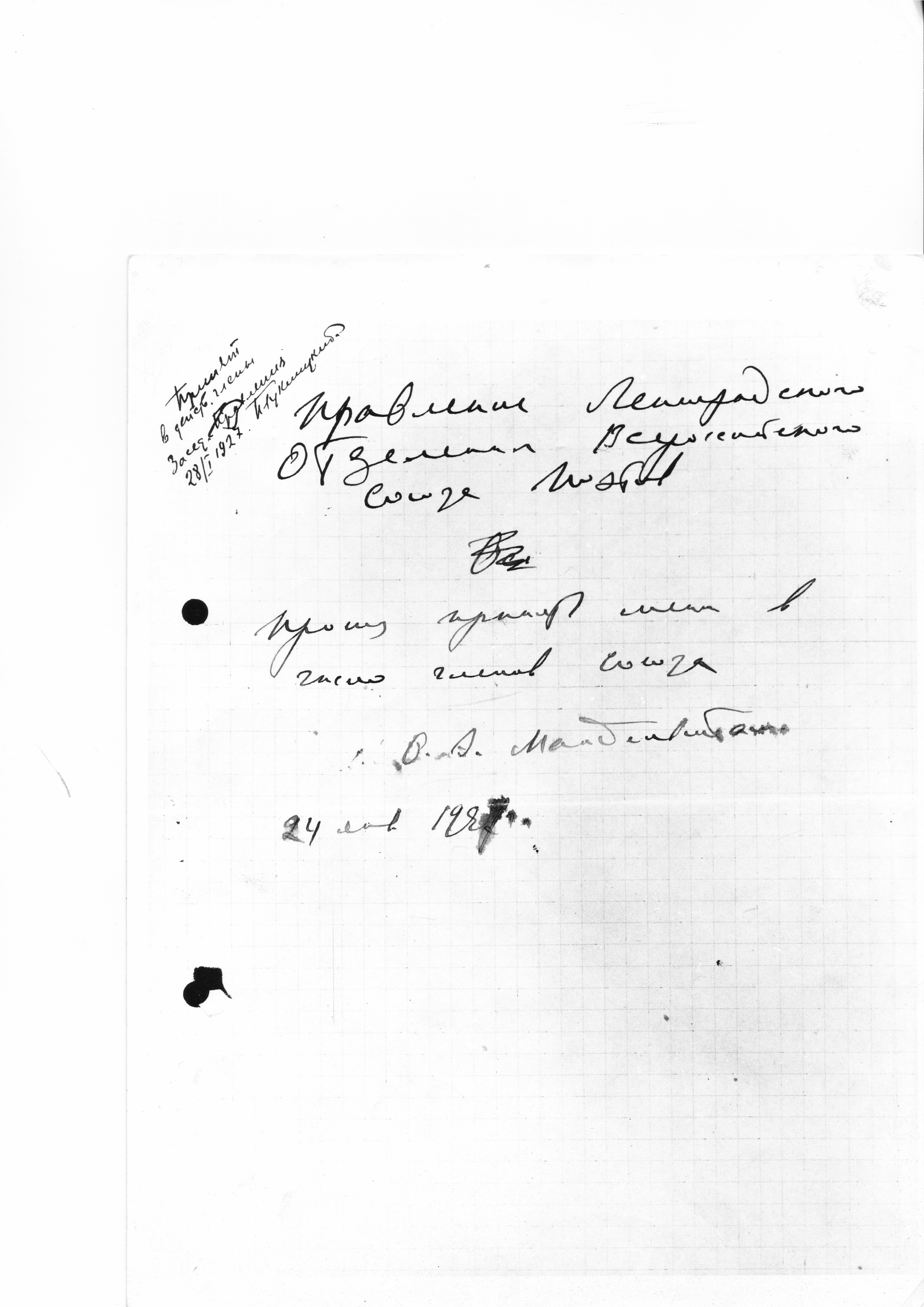
Your book also contains extraordinary documents, some of which are genuinely chilling. One example is Ossip Mandelstam's one-line application for admission to the Union of Poets, dated 27 January 1927, followed four days later by the resolution: "Admitted." You then reproduce the complete list of the Union's members at the end of 1928: sixty-two names. In an article marking the organisation's fifth anniversary, its authors noted with "great satisfaction" the "absence among the members of any trace of bohemian attitudes", which, they wrote, "undoubtedly testifies to the moral health of the Union". Do you know how many members of this morally healthy organisation were fortunate enough to die of natural causes?
I cannot say for certain. Andrei Ustinov probably could. What is obvious is that most of them were helped to an early grave. We published that list, incidentally for the first time in its entirety, as an invitation to other researchers to continue the work.
I very much hope there will be successors. The history of Russian culture still contains many coded pages waiting to be deciphered.


Лазарь Фрейдгейм August 26, 2026
Sikorsky August 26, 2026
kostya goldtv August 30, 2026