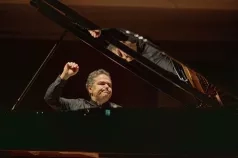
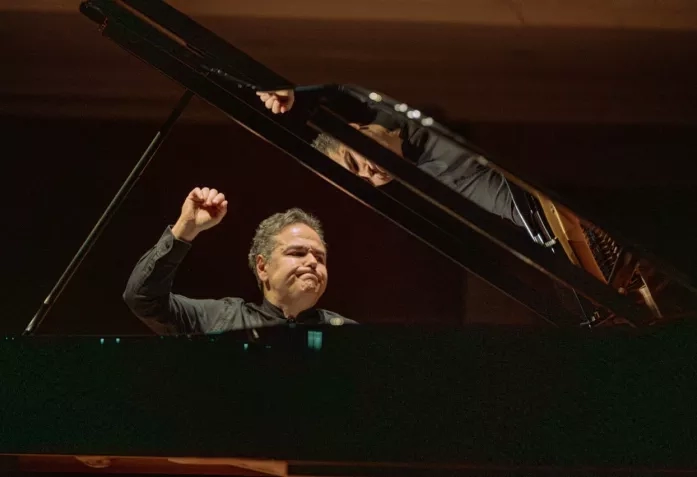
I first heard Arcadi Volodos live in 2019, when he stepped in at short notice and brilliantly replaced the American pianist Murray Perahia in Caecilia’s “Les Grands Interprètes” series. He made a powerful impression on me: it was immediately clear that this is a pianist for whom technique has long ceased to be an issue, and for whom sound has become a way of thinking. So I am glad to say a few words about him ahead of his next appearance, as Caecilia closes its Geneva season with his concert at Victoria Hall.
Arcadi Volodos was born in 1972 in Leningrad into the family of the opera singer Arkady Volodos. He first studied singing, most likely under his father’s influence, at the Glinka Choral School, and only at the age of sixteen did he turn seriously to the piano, enrolling at the college affiliated with the Moscow Conservatory, from which he graduated in 1991 in the class of Galina Eghiazaryan. Almost immediately afterwards he left for abroad. In 1991–1992 he studied at the Paris Conservatoire with Jacques Rouvier, and in 1993 at the Reina Sofía School of Music in Madrid with Dmitri Bashkirov.
Volodos was not a child prodigy, was not part of the Russian “New Names” programme that produced so many stars in the 1980s and 1990s, did not take part in competitions, which he in fact rejects, and did not gain early fame in his home country, giving his first concert in Moscow only in 2005. From the mid-1990s, however, he has toured extensively worldwide. One might recall his legendary debut at Carnegie Hall in New York in 1998, the recording of which received a Gramophone award.
Volodos first attracted the attention of professionals and audiences in the early 1990s with his virtuoso piano transcriptions, and the press immediately dubbed him “the new Horowitz”. In 2000 he was awarded the Franco Abbiati Prize, and in 2003 the Accademia Chigiana Prize and the German ECHO Klassik Award as Pianist of the Year.
His recording Volodos in Vienna, made in the Great Hall of the Vienna Musikverein and released by Sony in February 2010, was named best in the “Instrumental” category by Gramophone. The album Volodos plays Brahms received the Gramophone, Diapason d’or and Edison Classical Awards in 2018. Among his other significant recordings are Prokofiev’s Second Piano Concerto, Rachmaninoff’s First and Third Concertos, Tchaikovsky’s First Concerto, works by Scriabin and Liszt, as well as pieces by the Catalan composer Federico Mompou, who, because of his extreme shyness, abandoned a career as a pianist to devote himself entirely to composition. A new recording made in Paris, devoted to Schubert and Schumann, will be released very soon, so it is hardly surprising that these two names appear on the programme of the forthcoming concert of Arcady Volodos in Geneva.
His programmes are almost always shaped as statements, not a selection of “beautiful” pieces, but a carefully constructed trajectory in which not only the works themselves matter, but also the transitions between them, the tension that arises in the pauses, and the particular sense of time he shapes from the first bar to the last.
This time, the journey leads from Franz Schubert to Frédéric Chopin. Yet this movement from classical form to romantic expression is only an outward outline. In reality, it is a much subtler shift, from a light that has not yet become aware of its own fragility to a memory that can no longer be painless.
The Sonata in G major, D 894, Op. 78, completed in October 1826 and the last to be published during the composer’s lifetime, is one of Schubert’s most expansive works, with performances by pianists such as Sviatoslav Richter extending to forty-five minutes instead of the usual thirty-five, and at the same time one of his most inward. There are almost no dramatic gestures here, but rather a rare state of inner equilibrium that is easy to destroy and almost impossible to restore once lost. This is music not of development but of being, not of conflict but of sustaining. Robert Schumann considered it “the most perfect in form and conception” of all Schubert’s sonatas. I have no doubt that, hearing it performed by Arcadi Volodos, you will agree that his art lies not in “telling” us Schubert, but in not disturbing his breathing. Long phrases, barely perceptible dynamic shifts, almost invisible pedalling all combine to create a listening experience in which time ceases to be linear.
The second half of the programme is Frédéric Chopin, but without the familiar decorative surface and without any “salon” veneer. Three mazurkas, one each from Op. 33 (Mesto), Op. 42 No. 2 and Op. 63 No. 2, sound here as fragments of memory, not the dance itself but its trace, not the form but its blurred echo. The rhythm does not hold steady, but seems to waver, constantly shifting, as if its very foundation were unstable.
The Prelude in C-sharp minor, Op. 45, one of Chopin’s most enigmatic musical texts, appears as a transition, a free, almost improvisatory fabric in which there are no longer any fixed points of reference, yet a sense of inevitability remains.
Finally, the Sonata No. 2 in B-flat minor, Op. 35, completed in 1839 and first published a year later. It is a work that resists being heard “as a whole” without a certain inner tension, its four movements being so different in nature that Schumann described them as “four of Chopin’s most unruly children”. Even a listener far unfamiliar classical music knows the third movement, the famous Funeral March, often performed separately on various solemn occasions. It is hard to understand how, after this slow and solemn movement, Chopin chose to conclude the Sonata with a swift Presto! Remarkably, in Volodos’s interpretation this Sonata ceases to be a set of contrasts and becomes a coherent experience, one that does not smooth over its contradictions, but renders them internally necessary, subordinated to a single line that leads not to effect, but to meaning.
Thus, a programme that at first glance follows the classical pattern “from Schubert to Chopin” proves to be a statement about time and memory, about how music holds on to what is slipping away and how it marks the moment when such holding becomes impossible.
Dear friends, this is a concert in which what matters is not only what is heard, but what remains afterwards.
Shall we meet on 8 June at Victoria Hall? Do hurry, only a few tickets remain.