
An Ecological Thriller Inspired by Blake

Almost exactly eight years ago, in November 2018, I had the honour and pleasure of attending the Jan Michalski Prize ceremony in Montricher. That evening, Olga Tokarczuk received the award for The Books of Jacob from Vera Michalski-Hoffmann. The jury certainly had an eye for talent: by October the following year, the Swedish Academy had announced that Tokarczuk had won the 2018 Nobel Prize in Literature.
By then, the Polish writer was already well known to French-speaking readers. Robert Laffont had published Primeval and Other Times (Dieu, le temps, les hommes et les anges) and House of Day, House of Night (Maison de jour, maison de nuit), both of which had also been translated into Russian. The Swiss publisher Noir sur Blanc had brought out Récits ultimes (2007), Flights (Les Pérégrins, 2010) and The Books of Jacob (Les Livres de Jakób, 2018). The latter two appeared in English as Flights (2017) and The Books of Jacob (2021). In 2020, Noir sur Blanc published Histoires bizaroïdes and Le Tendre Narrateur, a collection that includes Tokarczuk’s Nobel lecture. The Swiss publisher went on to bring out a new French translation of Maison de jour, maison de nuit (2021), Jeu sur tambours et tambourins (2023), Le Banquet des Empouses (2024) and E.E. (2025). Le Banquet des Empouses also appeared in English in 2024 as The Empusium: A Health Resort Horror Story.
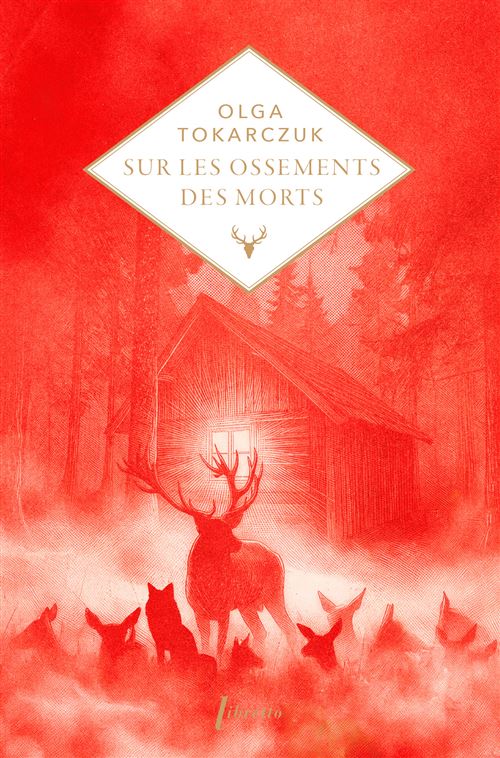
It was also Noir sur Blanc that published Drive Your Plow Over the Bones of the Dead in French in 2012, as Sur les ossements des morts, translated from the Polish by Margot Carlier. Libretto has now brought it out in a handsome collector’s edition, giving me a welcome chance to remind those who’ve read this strange novel of what it has to offer, and to recommend it to those who have yet to meet Janina Duszejko.
Olga Tokarczuk was born in Sulechów, Poland. Her father came from the borderlands of Galicia and Podolia, her mother from the Święty Krzyż region. While studying psychology at the University of Warsaw, she discovered the work of the Swiss psychiatrist Carl Gustav Jung. ‘It seemed to me that Jung brought together two things that mattered to me: trust in experience and intellect, and those powerful inner insights without which life would be hard to swallow, like a piece of dry bread,’ she recalled. In several of her novels, which are close to magical realism, everyday life is interwoven with myth. A feminist, an environmental activist who was for a time a member of the Polish Green Party, and a vegetarian, Tokarczuk speaks out in defence of animals.
Her interest in poetry also matters in Drive Your Plow Over the Bones of the Dead. All seventeen chapters open with quotations from William Blake (1757–1827), whose work also gives the novel its title. It is worth remembering that some of the English poet’s contemporaries thought him mad, while later critics recognised the philosophical and mystical depth of his work.
I think Tokarczuk lent her heroine a little of her own experience. Let’s hope it was only a little: the assurance with which Janina Duszejko appoints herself plenipotentiary of the animal kingdom is funny at first, then starts to become frightening. To a Russian ear, her surname, which strikes me as more Ukrainian than Polish, contains the word dusha, ‘soul’.
The first chapter, ‘Now Pay Attention’, opens with these lines from Blake’s The Marriage of Heaven and Hell.
Once meek, and in a perilous path,
The just man kept his course along
The vale of death.
The novel’s first sentence could be a joke in its own right: ‘I am already at an age and additionally in a state where I must always wash my feet thoroughly before bed, in the event of having to be removed by an ambulance in the Night.’
In Irina Adel’geim’s Russian translation, I stumbled over the capital N in ‘Night’. A typo? Then came the Murk, Saturn, Roe Deer, Wild Boar, Foxes and the Little Girls… In the Polish original, as in Russian and English, Janina capitalises words for Animals as though they were proper nouns, just as she does with planets and natural phenomena. (Margot Carlier did not follow that practice in French.) The creatures and forces Janina names this way all have a part to play. But for now, an anxious neighbour whom Janina calls Matoga, or, Oddball is standing on her doorstep. He has come to announce the very opposite of Good News: another neighbour, Big Foot, has been found dead. Janina sets about things so briskly that I immediately thought of Agatha Christie’s Miss Marple. (Matoga is an old Polish word for a ghost or a monster.)
Janina lives near the Czech border, in a hamlet that all but empties in winter. She keeps a conscientious eye on the holiday homes in her care and sometimes has trouble getting through to Wrocław because her phone switches to a Czech network. (People in Geneva know what it’s like when French networks muscle in.) The hamlet doesn’t even have an official name. That anonymity seems fitting to me: it’s easy to imagine the people and the way things are done here somewhere else. Almost anywhere, in fact.
In real life, I doubt I’d have tried to get close to Janina: she pokes her nose into other people’s business, fires off one complaint after another and can be quite venomous. You wouldn’t want to be on the receiving end of that sharp tongue. Looking down at the feet of the dead neighbour she couldn’t stand, Janina concludes, as translated by Antonia Lloyd-Jones: ‘He couldn't have been human. He must have been some sort of nameless form, one of the kind that – as Blake tells us – melts metals into infinity, changes order into chaos. Perhaps he was a sort of devil.’ Hardly an expression of love for one’s fellow man, would you say? Yet by the next paragraph she feels sorry for Big Foot. Perhaps his mother abandoned him? Perhaps he had an unhappy childhood? In the space of a few lines, she sees him first as a devil, then as a man whom life hasn’t spared.
My feelings about the heroine changed from scene to scene. I quite understand her fury at the inaction of the police and the Commandant’s undisguised arrogance. ‘We’re the police for humans,’ he tells the woman everyone takes for a crank. But there’s more to Janina than meets the eye. ‘Cold irony is Urizen’s basic weapon. The armaments of impotence,’ she observes. In a village where hunting brings together people with money and power, it soon becomes clear whom she needs that weapon against. ‘For us there’s no such thing as private land, madam,’ one of the local rich men snaps. Power in a nutshell! Janina can give as good as she gets. She has a theory about the oversized cars she can’t stand: ‘I am convinced that their owners have small dicks and compensate for this deficiency by having large cars.’
Janina is hardly some provincial ignoramus who’ll believe whatever she’s told, even if she leaves the television on all day, tuned to a single channel devoted to the weather. (I can’t resist quoting what she says about why other media don’t interest her: ‘Newspapers rely on keeping us in a constant state of anxiety, on diverting our emotions away from the things that really matter to us.’) She teaches children English, quotes Faust in German, translates Blake and practises astrology at something close to a professional level. For years she has collected dates of birth and death to see whether a horoscope can tell her when and how someone will die. ‘A project without funding from the European Union. A kitchen-table project,’ she points out. Her ‘archive’ holds 1,042 dates of birth and 999 dates of death. ‘I know the date of my own death and that makes me feel free,’ says Janina. ‘It’s good to be absolutely certain of something.’ Yet when it comes to the positions of the planets, she admits: ‘I see them through the lens of my own fear.’ And then: ‘I see nothing but Catastrophes.’ Janina calls her Suzuki the Samurai, makes a point of saying she’s ‘not a Catholic’ and uses the word ‘God’ only in quotation marks.
Janina sleeps badly. She takes hops and valerian before bed, suffers from nightmares and is forever complaining of various ‘ailments’ whose cause no one could establish, even in hospital. She sets out her theory that animals are taking revenge on hunters quite openly in her letters to the police, but she’s regarded as an eccentric and so nobody takes her seriously. How could one not think of the crime reports? Sometimes it’s only after a tragedy that we learn that people had long noticed something odd about the culprit’s behaviour, and that neither those around them nor the police had paid much attention.
Janina has clearly read widely, at least in the areas that interest her. To persuade the police to take her theory seriously, she cites some curious historical examples, including the case of Himmler’s astrologer, who had warned of a danger facing Hitler. She also cites the Bible and old trials in which animals stood accused. Through her heroine, Tokarczuk tells us, for instance: ‘In Basel in 1471, a Hen was put on trial for laying unusually brightly coloured eggs. She was sentenced to be burnt at the stake on suspicion of being in league with the Devil.’ Janina is appalled by human cruelty, but she cites the case as a precedent: if people once thought animals capable of committing a crime, why do the police now refuse to consider the possibility? Intrigued by the Basel hen, I did a little digging. In an entry dated 4 August 1474, the Basel chronicler Johann Knebel uses the Latin word gallus, ‘cock’. According to him, the cock was handed over to the executioner for laying an egg. Knebel says nothing about a trial or an accusation of being in league with the Devil. So which was it, a cock or a hen?
There is another word in the book worth pausing over. The Polish ambona can mean either a church pulpit or a hunting hide on a raised platform. From one you preach sermons, from the other you watch for game, luring it in with food. When the local school presents St Hubert, the patron saint of hunters, in all seriousness as a model for modern environmentalists, and the priest explains that hunters are practising sound game management by shooting animals, to my ear, the irony has turned to satire. And I think of what Janina says about her endless mourning for every dead animal. A police officer tells her she has more compassion for animals than for people. ‘That’s not true,’ she replies. She feels just as sorry for both. ‘But nobody shoots at defenceless people,’ she says. ‘At least, not yet.’
You can hardly accuse Janina of indifference. Everything provokes a strong reaction, which she often calls ‘righteous anger’. Even her own name makes her indignant. She can’t bear to be addressed as ‘Pani Janina’ and tries on other names, Emilia and Joanna. The Norwegian scholar Ellen Mortensen sees two women who took up arms behind those names, Emilia Plater and Joan of Arc. France’s national heroine needs no introduction, but perhaps not everyone knows that Emilia Plater, one of the heroines of the Polish uprising of 1830–31 against the Russian Empire, is celebrated in Adam Mickiewicz’s The Death of the Colonel. The same uprising prompted a very different poetic response: Alexander Pushkin wrote To the Slanderers of Russia, addressing the French deputies and publicists who supported the insurgents and called for military intervention. It is for this very poem that all and sundry now pillory the great Russian poet, accusing him of backing Russia’s imperialist policies. (That’s where the ‘Russian accent’ came from, the one I had looked for in vain in Tokarczuk’s novel.)
It was Irina Adel’geim, the literary scholar who translated the novel into Russian, who led me to Dostoevsky. In a fascinating article published in Central European Studies in 2024, ‘Ethics and Pragmatics of Freedom: Author, Hero, Reader (Olga Tokarczuk and Janina Duszejko)’, she writes that Tokarczuk’s narrative can be read as containing ‘a certain ironic allusion to Dostoevsky’. She has in mind the way Janina comes increasingly under the sway of an idea and of her own understanding of free will. Adel’geim also notes ‘the conspicuous naïvety of many of Janina’s remarks’, in which the tragicomic nature of the character comes through. That is how my own feelings about Janina changed, I think: she struck me first as comic, then as tragicomic, and finally as tragic. ‘One has to tell people what to think. There’s no alternative. Otherwise someone else will do it.’ What frightens me in that remark is how sure Janina is of her right to decide for others. She is prepared to go far down that road, and that, to my mind, is the novel’s central moral question: how far can we go in the name of our own idea of justice? At what point does ‘righteous anger’ lead to acts that are anything but righteous?
There’s humour in the novel too. Black humour, admittedly. Over dinner, as the conversation turns to the death of another character, the entomologist Boros Schneider explains that, judging by the mould, the body had reached the stage of butyric fermentation. ‘We were eating pasta with blue cheese sauce,’ Janina adds imperturbably. The scene is almost vampiric, don’t you think? It certainly puts you off your dinner.
… I love a good detective story, but until almost the end of chapter fifteen I had no idea how this one would turn out. And I’m far from sure all readers will accept the ending. But the more our opinions differ, the more interesting it will be to compare them! I have no doubt that the novel is worth reading, if only for all it gives us to think about.