
“What is Cooking in the Kremlin”
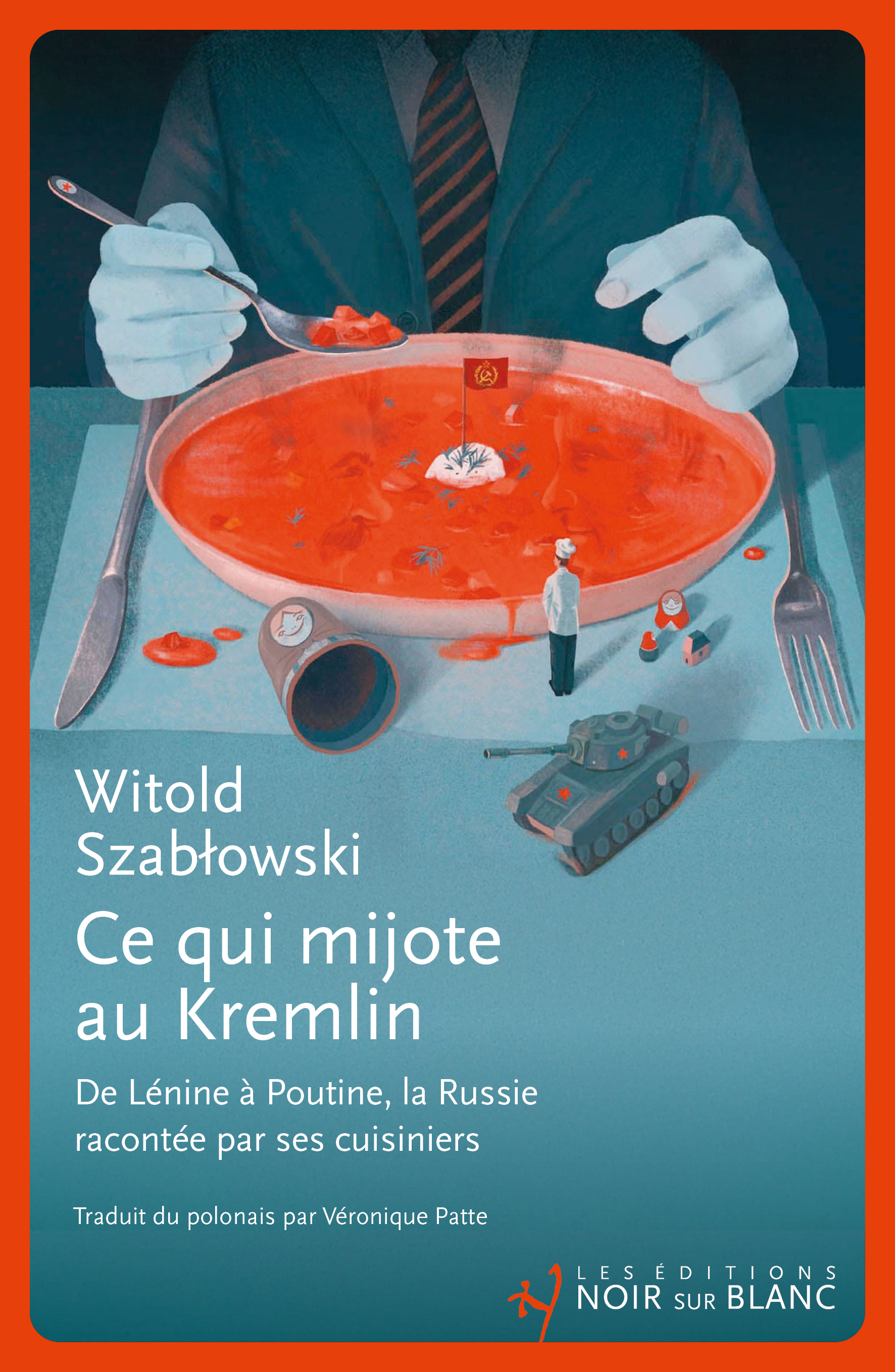
This new book marks the third collaboration between the respected Swiss publisher and Witold Szabłowski, born in 1980, who at the age of twenty-five became the youngest staff reporter of the Polish daily Gazeta Wyborcza and has received, among other distinctions, the European Parliament Prize for his reporting on migrants in Western Europe and the Ryszard Kapuściński Award for his investigation into the massacre of Poles in Ukraine in 1943. In 2021, his major report on the world of post-communism, Dancing Bears (Ours dansants), was published in Lausanne, followed in 2024 by How to Feed a Dictator (Comment nourrir un dictateur), a book described by the French newspaper Le Figaro as “a writer-journalist’s tour de force”.
Witold Szabłowski is, first and foremost, a journalist, who also studied political science at the University of Warsaw. Both aspects are reflected in all his writings, and this new book, first published in Polish in 2021, is no exception. One can assume that, had it been written a couple of years later, its geography would have been somewhat different, and certain emphases might have been placed differently too. Yet even in its present form, this attempt to tell the history of Russia through its cuisine, both literally and metaphorically, offers abundant material for reflection.
The concept of the book is appealing: the history of Russia in the twentieth and twenty-first centuries (and not, as the subtitle suggests, beginning with Lenin, but with the last Russian tsar, Nicholas II) is told through the cooks, or their descendants, of those in power. That is, through those who are the first to taste the food, at the risk of being poisoned, who have direct access to the leader and become witnesses to what is rarely recorded in official sources: intonations, habits, small gestures in which there is sometimes more truth than in archival documents. Here, the kitchen is not merely a detail of everyday life, but a kind of political instrument, and through episodes that may at first seem private, the System comes into view, compelling people from generation to generation to live by lies, if one reverses Solzhenitsyn’s famous formula. In my view, this is the book’s main strength.
… Although the subject would seem to be food, the book opens with a scene that is anything but appetising. “An odour of petrol, fruit wine and badly digested fried fish fills my nostrils. The smell of petrol comes from a barge that set out to sea an hour earlier, that of the wine and the fish most probably from the contents of the stomach that the drunken watchman has just vomited beneath my window,” we read on the first page. The scene takes place in Abkhazia, more precisely in New Athos, at what was once Stalin’s dacha and is now that of the president of this republic, proclaimed during the Georgian-Abkhaz war and recognised only by Russia, Nicaragua, Venezuela, Nauru and Syria. It was here, after a chachlik accompanied by tchatcha and conversations with local residents, that Witold Szabłowski conceived his new project.
On the map placed at the beginning of the book, there are fifteen points marking the route of his investigative journey. Some names are known to all (Moscow, Leningrad, Yekaterinburg, Chernobyl), others require a brief clarification (for example Baikonur, the cosmodrome in Kazakhstan from which Yuri Gagarin was launched into space, or Yalta, where Stalin, Churchill and Roosevelt met in 1945), while still others call for more extensive explanation (such as the Afghan city of Bagram, which during the Afghan War (1979–1989) was the country’s largest airport and a Soviet air force base).
The book contains not only important historical facts, from the merciless description of the execution of the tsar’s family to the grim statistics of dekulakization campaign and famine, but also amusing, almost anecdotal details and episodes. It is hard not to smile when reading the monologue of a guide leading a tour of Gorki Leninskie, the estate turned into a museum where the leader of the world proletariat spent the last days of his life; it is a ready-made sketch for a stand-up comedian, if only for the confession that Lenin never ate as well as when “the tsar was providing for him”. That is, in prison.
Particularly convincing are those sections of the book where private history does not merely illustrate an era but seems to resist it, when the person working in the kitchen is no longer just a functionary of the system but its silent commentator. There the book gains depth and begins to speak not only about Russia but about the nature of power as such. In my view, the most successful chapters in this respect are those devoted to the siege of Leningrad, Afghanistan and Chernobyl. “How many young men never returned? No point asking. That was the main problem of that war. The generals did not respect the officers. The officers did not respect the soldiers. And the soldiers respected no one, neither their superiors nor their comrades. You have probably heard of dedovchtchina, of this ‘bizutage’. The older soldiers beat the younger ones, forced them to polish their boots, make their beds, wash their clothes,” says the cook “Mama Nina” in her conversation with Witold Szabłowski. And she is also the one who praises Afghan pilaf, kishmish grapes, the generosity of that land, and shares the most unusual recipe I have ever encountered: “The month of February offers the most beautiful spectacle in the world: wild tulips in the steppes. They grow there by the millions, pressed tightly together. As soon as they begin to bloom, Afghans light small fires, pick the flowers and throw the bulbs into the embers. They roast them on all sides and eat them. It is slightly bitter, but edible.”
However, the conceptual originality of the book is also its weakness. The formula “history through the kitchen” works unevenly: in the strongest chapters, the kitchen truly becomes a key to understanding the period, while in the weaker ones it remains an effective frame that does not add fundamentally new knowledge.
And yet the book remains an engaging read and offers less ready-made answers than a way of looking at historical events: through the small to the large, through the particular to the systemic.
Finally, it should be noted that this book is likely to appeal not only to those interested in the history of Russia from Nicholas II to Putin, but also to those who simply enjoy cooking and eating, as each chapter contains several original recipes that can easily be reproduced at home, even when they come from a tsar’s table. With the publisher’s permission, I am sharing one of them here: “Pozharsky cutlets, tsar’s style”. It is worth adding that the popular legend linking the origin of these cutlets with Prince Dmitry Pozharsky, who liberated Moscow from the Polish-Lithuanian invaders in 1612, has nothing to do with reality. This simple and delicious dish owes its existence not to the prince but to his namesake, Evdokim Pozharsky, the owner of the Pozharsky inn and hotel in Torzhok in the early nineteenth century, as confirmed by the poet Alexander Pushkin, who wrote in 1826 to his friend and bibliographer Sergei Sobolevsky:
Take your time and dine
At Pozharsky’s in Torzhok,
Taste the fried cutlets
And set off light of heart.
Already in the nineteenth century, the fame of Pozharsky cutlets had spread beyond the borders of the Russian Empire. In his Voyage en Russie in 1867, the French poet Théophile Gautier reported that the recipe for these chicken cutlets had been given to an innkeeper by an unfortunate Frenchman who had no other means of paying for his lodging, while his compatriot and fellow writer Victor d’Arlincourt spoke of “des côtelettes Pojarsky” in the most superlative terms, noting that he had tasted them not made of chicken but of veal. Why not? I hope that some of my readers will be tempted to experiment according to their own taste.
Pozharsky cutlets in the tsar’s style
— 400 g chicken fillet
— 1 slice of bread (or a small roll)
— 1 egg
— 10% cream
— vegetable oil
— breadcrumbs
— ½ packet of butter
— salt
Finely mince the chicken fillet. Crumble the bread and soak it in the cream, leaving it to stand for 10 minutes. Then mix with the minced meat. Add the egg yolk, salt, knead, adding from time to time a spoonful of cold water until the mixture no longer sticks to the hands. Cut the butter into small cubes. Divide the mixture into 12 portions. Form each portion into a ball. Place a piece of butter inside each. Coat with breadcrumbs and fry.
Enjoy your reading – and your meal.